
This article's table of contents introduction:
- Breakdown of the Terminology
- Technical Characteristics of this Fan Type
- Energy Efficiency Details
- Comparison with Other Fan Types
- Typical Specifications (Example)
- Summary
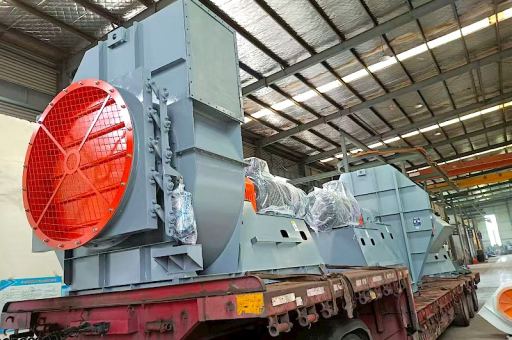
It appears you are describing a specific type of industrial fan, likely used in boiler systems, kilns, or industrial furnaces. Let me break down the terminology and provide a technical explanation of what this fan is, its features, and why it is specified.
Core Definition: You are describing a Radial (Centrifugal) Blower designed for backward-curved blades, handling flue gas (exhaust), and constructed from Q235 carbon steel, likely with a focus on energy efficiency.
Breakdown of the Terminology
- Q235: This is a Chinese standard (GB/T 700) carbon structural steel. It is equivalent to ASTM A36 or S235JR (EN 10025).
- Why use it? It is cheap, weldable, and strong enough for fan casings and impellers operating at moderate temperatures (typically under 300°C / 572°F).
- Energy Efficiency: This refers to the fan’s ability to convert motor power into airflow with minimal losses. A "backward" blade design is inherently more efficient than "forward-curved" or "radial" (straight) blade designs.
- Backward Flue Gas Exhaust Fan: The fan moves hot, potentially corrosive, and particulate-laden exhaust gas (flue gas) from a combustion process out of the system.
- Radial Fan Blower: This is a centrifugal fan. Air enters the center (axially) and is thrown outward (radially) by the spinning impeller. "Blower" implies it creates moderate to high pressure (typically 2-15 kPa / 8-60 inches w.g.).
Technical Characteristics of this Fan Type
Impeller Design (Backward-Curved):
- Shape: Blades curve away from the direction of rotation.
- Efficiency: High (75-85% static efficiency).
- Pressure: Medium to high pressure.
- Power Curve: "Non-overloading" power curve. This is critical for safety. As airflow increases, the motor power demand plateaus and then drops. You cannot burn out the motor by running the fan in a wide-open duct (unlike forward-curved fans).
- Dust Handling: Moderate. Backward blades are less prone to dust buildup than forward blades but not as resistant as "radial-tip" or "paddle-wheel" designs.
Application (Flue Gas):
- Temperature: Flue gas can range from 150°C to 400°C (300°F to 750°F). Q235 steel is suitable up to about 370°C (700°F). For higher temperatures, alloys (Q345, 16Mn, or stainless steel 304/316) are required.
- Corrosion: Flue gas contains sulfur (SOx) and moisture, forming sulfuric acid. Q235 requires protective coatings (e.g., acid-resistant paint, PTFE lining) or thicker material to handle corrosion.
- Particulates: Fly ash in flue gas erodes the impeller. Backward blades are less susceptible to erosion than thin forward blades but require wear-resistant coatings (e.g., Hardox strips, ceramic tiles) for heavy dust loads.
Energy Efficiency Details
This fan type excels in energy efficiency due to:
- Low Internal Losses: The backward blade shape allows air to exit the impeller with lower velocity, resulting in less turbulence and friction loss in the volute casing.
- Stable Operation: The "non-overloading" feature ensures the motor runs at its rated power, avoiding overheating and reducing electrical losses.
- Variable Speed Ready (VFD): This design responds very well to Variable Frequency Drives (VFDs), allowing precise airflow control and massive energy savings compared to damper control.
Comparison with Other Fan Types
| Feature | Your Fan (Q235 Backward Radial) | Forward-Curved | Radial (Paddle Wheel) |
|---|---|---|---|
| Efficiency | High (85%) | Low (65%) | Low (50-60%) |
| Pressure | Medium-High | Low-Medium | High |
| Dust Handling | Moderate | Poor (dust sticks) | Excellent (self-cleaning) |
| Motor Safety | Non-overloading | Overloading (danger) | Non-overloading |
| Cost | Medium | Low | Medium-High |
Typical Specifications (Example)
If you are sourcing or specifying this fan, you would need parameters like:
- Model: e.g., 9-19 Series, 9-26 Series, or Y5-47 / Y5-48 Series (specifically for flue gas / boilers).
- Material: Impeller: Q235, Casing: Q235.
- Flow Rate: 10,000 m³/hr.
- Static Pressure: 4,000 Pa.
- Temperature: 200°C (max).
- Drive: Direct drive or Belt drive.
- Accessories: Inlet box (damper), expansion joint, vibration isolators.
Summary
You are looking at a high-efficiency, medium-pressure centrifugal fan built from standard steel, specifically engineered to handle hot, dirty exhaust gases. It is a good choice for industrial boilers, cement kilns, or chemical process heaters where energy cost is a major concern, but flue gas conditions are not extremely corrosive or abrasive.





