
This article's table of contents introduction:
- The Material: 16Mn (Now Q345B/Q355B)
- The Application: Metallurgy (Steel Mills, Smelters)
- The Requirement: Low Noise (Low Noise Design)
- Typical Technical Specifications (Example)
- Why 16Mn vs. Alternatives?
- Important Design Consideration for Metallurgy:
- Summary for Your Search
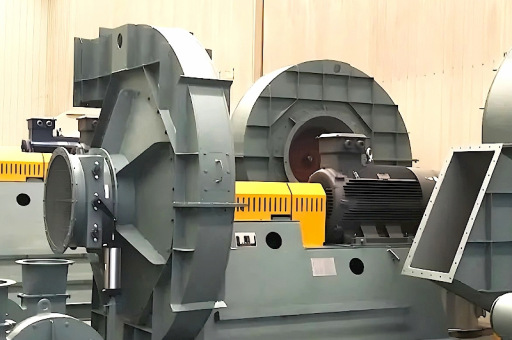
It appears you are looking for detailed information regarding 16Mn steel low-noise industrial centrifugal fans, specifically for applications in metallurgy.
I will break down the significance of each part of your query and provide the technical specifications, material properties, and application details.
The Material: 16Mn (Now Q345B/Q355B)
- What it is: 16Mn is an old Chinese standard (GB/T 1591) for a low-alloy high-strength structural steel. Its modern equivalent is Q345B or Q355B.
- Why it is used in Metallurgy Fans:
- High Strength: It has a yield strength of approx. 345 MPa, higher than standard carbon steel (Q235). This allows for thinner, lighter impellers while maintaining structural integrity at high speeds.
- Wear Resistance: In metallurgy, the air often contains dust, scale, and particles. 16Mn offers better abrasion resistance than plain carbon steel.
- Weldability: It welds well, which is crucial for fabricating complex impeller geometries and scroll housings.
- Toughness: It handles the vibration and thermal stress common in steel mills better than brittle cast iron.
The Application: Metallurgy (Steel Mills, Smelters)
In the metallurgical industry, fans are critical but operate in harsh environments. Common applications include:
- Induced Draft (ID) Fans: Suck hot, dirty flue gas from furnaces (blast furnaces, converters, reheating furnaces) through dust collectors and ducts.
- Forced Draft (FD) Fans: Supply combustion air to furnaces and boilers.
- Baghouse / Dust Collector Fans: Move heavy, abrasive dust (iron ore, coke, scale) through filtration systems.
- Quenching / Cooling Fans: For steel plate, wire, and casting cooling.
The Challenge: Standard fans fail quickly due to erosion (from dust) and imbalance (from particle buildup on blades).
The Requirement: Low Noise (Low Noise Design)
To be "low noise" in a metallurgy context, a centrifugal fan must have specific design features:
- Backward-Curved / Backward-Inclined Blades: These are inherently quieter than forward-curved (squirrel cage) or radial blades. They prevent the "siren" effect caused by air slamming into blades.
- Impeller/Volute Clearance: Tight, optimized clearances reduce turbulence and whistling.
- Thickened Blades (Anti-Wear): Even in a "low noise" design, the leading edges of the blades are often welded with a hardfacing layer (e.g., carbide overlay) or made thicker to withstand erosion. This also dampens vibration noise.
- Acoustic Enclosures: In many metallurgy plants, the fan itself is enclosed in a silencer or insulated housing.
- Dynamic Balancing: Low noise requires the impeller to be balanced to a high grade (e.g., G2.5) to eliminate mechanical rumble.
Typical Technical Specifications (Example)
Here is a hypothetical specification sheet for a 16Mn metallurgy fan:
| Parameter | Specification |
|---|---|
| Fan Type | 9-26 series or Y4-73 series (High pressure) |
| Material (Impeller) | 16Mn (Q355B) |
| Material (Housing) | Q235B (Carbon steel) or 16Mn for high temp |
| Max Temperature | 150°C - 350°C (Depending on bearing/cooling) |
| Speed | 1450 RPM or 980 RPM (4-pole / 6-pole motor) |
| Noise Level | ≤ 85 dB(A) @ 1m (with silencer) |
| Wear Protection | Tungsten Carbide spray or ceramic tile lining on impeller wear zone |
| Balance Grade | G2.5 (ISO 1940) |
Why 16Mn vs. Alternatives?
- vs. Q235 (Standard Steel): Q235 will erode and crack much faster.
- vs. Stainless Steel (304/316): Stainless can be used for corrosion (wet gases), but it is more expensive and has lower strength-to-weight ratio than 16Mn for purely abrasive dry dust.
- vs. Corten Steel (Weathering): Corten is used for structural parts but not typically for high-speed impellers.
Important Design Consideration for Metallurgy:
The Rotor. The impeller is the most critical part.
- A 16Mn impeller must be stress-relieved after welding to prevent cracking.
- Hollow blades or profiled blades are often used to allow for cooling and reduce weight.
- For extremely high temperatures (>400°C), 16Mn loses its strength, and you must switch to Q345R (Boiler plate) or 15CrMoR (Alloy steel) .
Summary for Your Search
If you are sourcing these fans, you need to ask the supplier these key questions:
- Is the impeller made of 16Mn (or Q355B), and is it stress-relieved?
- What is the noise level guarantee (dB(A) at a specific distance)?
- What wear protection is applied to the leading edge of the blades?
- Is the balance grade G2.5 or better?
- Is this fan suitable for metallurgical dust (e.g., iron oxide, coke fines)?
Keywords for further search: Y4-73 16Mn fan, metallurgy dust removal centrifugal blower, high temperature induced draft fan steel mill, low noise heavy duty impeller.





