
This article's table of contents introduction:
- 16Mn (Material Specification)
- Backward (Blade Design / Impeller Type)
- Energy Efficiency (Performance Feature)
- Antiwear (Application Feature)
- Material Handling (Application)
- Full Technical Summary
- Summary Table
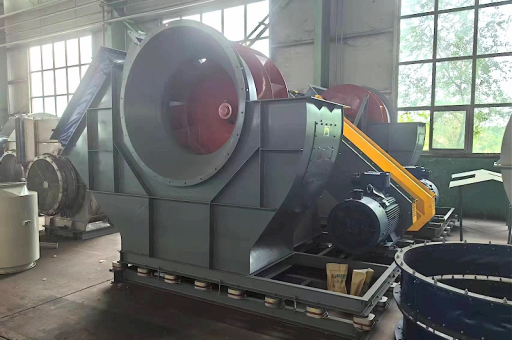
The phrase you've provided, "16Mn Backward Energy Efficiency Antiwear Material Handling Blower," appears to be a highly specific product description, likely for an industrial centrifugal fan or blower.
Let's break down what each term means to give you a full technical definition.
16Mn (Material Specification)
- What it is: This is a Chinese standard designation for a specific grade of low-alloy, high-strength structural steel.
- Composition: It contains approximately 12-0.20% Carbon and 20-1.60% Manganese (hence "16Mn").
- Properties: It offers higher yield strength (approx. 345 MPa) and better wear resistance than standard Q235 carbon steel.
- Why used here: For a "material handling" blower, this steel is chosen because the material being moved (dust, pellets, grains, chips) is abrasive. 16Mn resists erosion and wear from particle impact better than softer steels, extending the blower's lifespan.
Backward (Blade Design / Impeller Type)
- What it is: Refers to Backward Curved (BC) or Backward Inclined (BI) blades on the impeller.
- Characteristics:
- Blades curve away from the direction of rotation.
- High Efficiency: This is the most energy-efficient blade design. It converts air velocity into pressure with minimal turbulence.
- Non-Overloading Power Curve: The motor will not burn out if the system pressure drops or ductwork opens, because power draw peaks at a specific operating point and then decreases.
- Higher Speed: Typically runs at higher speeds (RPM) than forward-curved fans.
- Why used here: To achieve the "Energy Efficiency" mentioned in the name.
Energy Efficiency (Performance Feature)
- Why it matters: A backward-curved impeller is inherently more efficient (often 75-85% static efficiency) compared to forward-curved or radial blade designs. For a blower running continuously in a factory, this directly translates to lower electricity bills and reduced carbon footprint.
Antiwear (Application Feature)
- Why it matters: Material handling involves transporting abrasive materials (e.g., sand, cement, wood chips, plastic pellets, grain dust).
- Engineering for anti-wear:
- The use of 16Mn steel for the impeller and housing.
- Often includes thicker material (e.g., thicker gauge steel for the housing).
- May include replaceable wear liners (rubber or ceramic) inside the housing at high-impact zones (cut-off, volute tongue).
- The backward curved design helps reduce the impact velocity of particles on the impeller blades, inherently reducing wear compared to a radial paddle wheel.
Material Handling (Application)
- What it does: This blower is designed to move a mixture of air and solid particles (pneumatic conveying).
- Common uses:
- Dust collection systems (baghouses, cyclones).
- Pneumatic conveying systems (moving grains, plastics, chemicals).
- Industrial ventilation in foundries, woodworking shops, cement plants, and steel mills.
Full Technical Summary
What is "16Mn Backward Energy Efficiency Antiwear Material Handling Blower"?
It is a heavy-duty, high-efficiency centrifugal fan built from 16Mn high-strength steel to resist abrasion. It utilizes a backward-curved impeller design to maximize energy efficiency and prevent motor overloading. It is specifically engineered for pneumatic conveying and dust collection systems where the moving air contains abrasive solid materials.
Typical "Pros" of this specific blower:
- ✅ Long Life: Resists wear from sand, dust, and pellets.
- ✅ Low Energy Cost: The backward curve design is highly efficient.
- ✅ Safe Operation: Non-overloading power curve protects the motor.
- ✅ High Pressure: Capable of generating medium to high pressure needed to overcome friction in ductwork.
Typical "Cons" / Limitations:
- ❌ Higher Initial Cost: More expensive than a standard Q235 carbon steel fan.
- ❌ Not for Sticky Materials: Backward curved blades can clog with very moist or sticky materials (a radial paddle blade might be better for that).
- ❌ Noise: May be slightly noisier than a forward-curved fan at the same duty point (often requires a silencer).
Summary Table
| Feature | What It Means |
|---|---|
| 16Mn | Strong, wear-resistant steel (high manganese content). |
| Backward | High-efficiency impeller shape (blades curve away from rotation). |
| Energy Efficiency | Low operating cost (high static efficiency). |
| Antiwear | Designed to handle abrasive dust/solids without failing quickly. |
| Material Handling | Used for conveying solids in air (pneumatic conveying, dust collection). |





