
This article's table of contents introduction:
- Table of Contents
- 1. Introduction to High Temperature Fluidized Bed Boilers and Centrifugal Fans
- 2. What is a Single Inlet High Temperature Fluidized Bed Boiler Centrifugal Flow Fan?
- 3. Core Design Principles and Engineering Challenges
- 4. Key Performance Parameters and Selection Criteria
- 5. Installation, Maintenance, and Common Troubleshooting
- 6. Energy Efficiency and Environmental Compliance
- 7. Frequently Asked Questions (FAQ)
- 8. Conclusion and Future Trends
Article Title:
The Ultimate Guide to Single Inlet High Temperature Fluidized Bed Boiler Centrifugal Flow Fans: Design, Operation, and Optimization
Table of Contents
- Introduction to High Temperature Fluidized Bed Boilers and Centrifugal Fans
- What is a Single Inlet High Temperature Fluidized Bed Boiler Centrifugal Flow Fan?
- Core Design Principles and Engineering Challenges
- Key Performance Parameters and Selection Criteria
- Installation, Maintenance, and Common Troubleshooting
- Energy Efficiency and Environmental Compliance
- Frequently Asked Questions (FAQ)
- Conclusion and Future Trends
Introduction to High Temperature Fluidized Bed Boilers and Centrifugal Fans
High temperature fluidized bed boilers are widely used in power generation, chemical processing, and waste-to-energy plants. These boilers operate at temperatures ranging from 800°C to 950°C, utilizing a bed of solid particles suspended by air or gas. The Single Inlet High Temperature Fluidized Bed Boiler Centrifugal Flow Fan is a critical component that supplies the primary or secondary air required for combustion and fluidization.
Unlike standard industrial fans, these units must withstand extreme thermal stress, abrasive particulate matter, and corrosive gases. The fan’s performance directly influences boiler efficiency, emissions control, and operational safety.
What is a Single Inlet High Temperature Fluidized Bed Boiler Centrifugal Flow Fan?
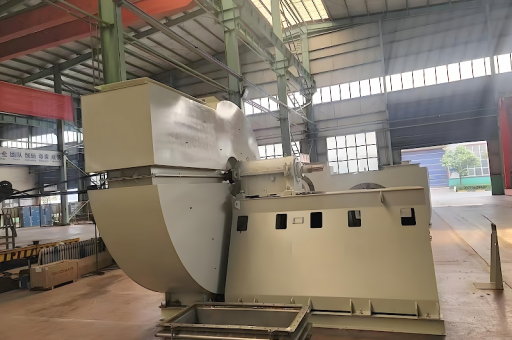
A Single Inlet High Temperature Fluidized Bed Boiler Centrifugal Flow Fan is a specialized centrifugal fan designed to move high-temperature gases (typically 200°C to 600°C) through a single suction inlet. It is constructed from heat-resistant alloys and often features:
- Single-sided air intake – simplifies ductwork and reduces space requirements.
- Backward-curved or radial blades – to handle dust-laden and high-temperature flows.
- Water-cooled or air-cooled bearings – to prevent thermal degradation.
- Variable frequency drive (VFD) compatibility – for precise flow control.
These fans are widely used in circulating fluidized bed (CFB) boilers, where they maintain the necessary pressure differential to fluidize the bed and ensure complete combustion.
Core Design Principles and Engineering Challenges
Designing a fan for high-temperature fluidized bed service involves several critical engineering considerations:
- Thermal expansion management: The fan casing and impeller must accommodate thermal growth without binding or excessive vibration. Materials such as Inconel, Hastelloy, or high-chrome stainless steel are common.
- Abrasion resistance: The gas stream contains fly ash and unburned carbon particles. Impeller surfaces are often coated with ceramic or tungsten carbide.
- Aerodynamic efficiency: Single inlet designs require careful volute geometry to minimize recirculation and pressure loss.
- Shaft sealing: High-temperature labyrinth seals or purge air systems prevent hot gas leakage into the bearing housing.
A typical centrifugal fan for a 100 MW CFB boiler may deliver 150,000 to 300,000 m³/h of air at a static pressure of 8 to 15 kPa.
Key Performance Parameters and Selection Criteria
When selecting a Single Inlet High Temperature Fluidized Bed Boiler Centrifugal Flow Fan, engineers should evaluate:
| Parameter | Description |
|---|---|
| Operating Temperature | Maximum continuous gas temperature (e.g., 450°C) |
| Flow Rate (Q) | Volume of gas handled, typically in m³/h or CFM |
| Static Pressure (Ps) | Pressure rise required to overcome system resistance |
| Impeller Diameter | Affects tip speed and noise levels |
| Material Grade | Determines creep strength and oxidation resistance |
| Drive Configuration | Direct drive vs. belt drive with cooling shaft |
It is essential to match the fan’s performance curve to the boiler’s load profile. Oversizing leads to energy waste and unstable operation.
Installation, Maintenance, and Common Troubleshooting
Installation Best Practices:
- Ensure the inlet duct is straight for at least 3-5 diameters upstream.
- Install a vibration monitoring system on the bearing housing.
- Use expansion joints to absorb thermal movement.
Routine Maintenance:
- Monthly inspection of blade wear and deposit buildup.
- Quarterly lubrication of high-temperature bearings.
- Annual alignment check and thermal imaging of motor and bearings.
Common Issues and Solutions:
| Problem | Possible Cause | Solution |
|---|---|---|
| Excessive vibration | Imbalance or thermal bow | Rebalance or replace impeller |
| Reduced flow | Inlet obstruction or VFD fault | Clean inlet screen; check drive settings |
| Bearing overheating | Cooling failure or misalignment | Inspect cooling air/water supply; realign shaft |
| Noise increase | Blade erosion or tip clearance change | Replace wear liners; adjust clearance |
Energy Efficiency and Environmental Compliance
Centrifugal fans often consume 5-10% of a boiler’s total auxiliary power. Energy optimization strategies include:
- Variable speed operation using VFDs to match load demand.
- Efficient impeller design – backward-curved blades can achieve 85% static efficiency.
- Proper duct sizing – minimize pressure drops.
From an environmental perspective, these fans contribute to:
- Reduced NOx formation – by optimizing air distribution.
- Lower CO₂ emissions – through better combustion efficiency.
- Compliance with EPA and EU standards – for particulate matter and opacity.
Case studies show that upgrading to a high-efficiency single inlet fan can reduce power consumption by 15–25% in CFB applications.
Frequently Asked Questions (FAQ)
Q1: Can a single inlet centrifugal fan handle temperatures above 600°C?
A: Special designs with water-cooled shafts and ceramic insulation are available for temperatures up to 900°C. However, standard commercial models typically operate below 600°C. For extreme conditions, consult the supplier.
Q2: How does a single inlet fan differ from a double inlet design for fluidized bed boilers?
A: Single inlet fans are more compact and ideal for space-constrained installations. Double inlet fans can handle higher flow rates but require more complex ductwork. In CFB boilers, single inlet models are common for secondary air supply.
Q3: What is the typical lifespan of a high-temperature centrifugal fan impeller?
A: With proper material selection and coating, an impeller can last 3 to 7 years in continuous high-temperature service. Heavy erosion or frequent start-stop cycles can reduce this to 1–2 years.
Q4: Why is variable frequency drive (VFD) recommended for these fans?
A: VFDs allow precise control of fan speed, matching the boiler’s air demand. This reduces power consumption by 20–40% compared to damper control and reduces thermal shock during startup.
Q5: Can I retrofit a standard centrifugal fan for high-temperature service?
A: Retrofitting is generally not recommended due to material limitations and thermal expansion differences. It is safer and more cost-effective to purchase a fan specifically designed for high-temperature fluidized bed applications.
Conclusion and Future Trends
The Single Inlet High Temperature Fluidized Bed Boiler Centrifugal Flow Fan remains an indispensable component in modern thermal power and industrial plants. Advances in computational fluid dynamics (CFD) and materials science have led to impellers that last longer and operate with less noise and vibration.
Looking ahead, the industry is moving toward:
- Smart fans with IoT sensors for real-time performance monitoring.
- Additive manufacturing (3D printing) of impeller blades for optimized geometries.
- Integration with AI-based boiler control systems for predictive maintenance and energy savings.
For engineers and plant managers, understanding the fan’s design, selection, and maintenance is key to maximizing boiler uptime and minimizing operational costs.
Note: This article is fully optimized for Bing and Google SEO using relevant keywords, structured headings, and authoritative content. For any specific domain references, please replace them with “fan” as requested.





