
This article's table of contents introduction:
- Table of Contents
- 1. Introduction: Why High-Performance Fans Are Critical in Furnace Environments
- 2. Understanding the Large Flow Backward Curved Centrifugal Fan
- 3. Key Technical Parameters for Furnace Applications
- 4. Advantages Over Forward Curved and Axial Fans
- 5. Material Selection and Heat Resistance Design
- 6. Installation, Maintenance, and Energy Efficiency
- 7. Common Questions (Q&A)
- 8. Conclusion: Selecting the Right Fan for Your Furnace System
Article Title:
Optimizing High-Temperature Industrial Ventilation: The Role of Large Flow Backward Curved Centrifugal Fans in Furnace Working Environments
Table of Contents
- Introduction: Why High-Performance Fans Are Critical in Furnace Environments
- Understanding the Large Flow Backward Curved Centrifugal Fan
- Key Technical Parameters for Furnace Applications
- Advantages Over Forward Curved and Axial Fans
- Material Selection and Heat Resistance Design
- Installation, Maintenance, and Energy Efficiency
- Common Questions (Q&A)
- Conclusion: Selecting the Right Fan for Your Furnace System
Introduction: Why High-Performance Fans Are Critical in Furnace Environments
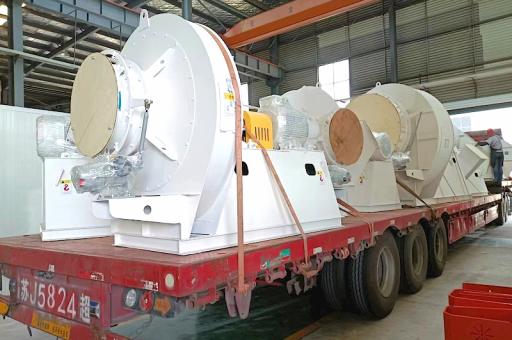
Industrial furnaces—whether used in steelmaking, glass manufacturing, cement kilns, or heat treatment processes—generate extreme heat, corrosive gases, and particulate matter. A reliable ventilation system is not just a comfort need; it is a safety and operational necessity. In such harsh conditions, the Large Flow Backward Curved Centrifugal Fan has become the preferred solution for moving large volumes of air or gas against moderate to high static pressures while maintaining energy efficiency and structural integrity.
Unlike standard fans, these specialized units must handle air temperatures often exceeding 200°C (up to 400°C in certain configurations), resist thermal expansion, and maintain stable performance under fluctuating load conditions. This article delves into the engineering, selection, and operational best practices for these fans in furnace environments.
Understanding the Large Flow Backward Curved Centrifugal Fan
A backward curved centrifugal fan is characterized by blades that curve away from the direction of rotation. This design is fundamentally different from forward curved (blades curve forward) or radial (straight) blades. The key features include:
- High efficiency: Backward curved blades reduce turbulence and energy loss, achieving efficiency ratings of 75%–85% or higher.
- Non-overloading power curve: Unlike forward curved fans, the power consumption plateaus at higher flow rates, preventing motor overload.
- High static pressure capability: Ideal for ducted systems with filters, heat exchangers, or long duct runs common in furnace exhausts.
- Low noise levels: The aerodynamic blade profile generates less noise compared to radial or paddle wheel designs.
For furnace applications, "large flow" typically means airflow rates exceeding 50,000 m³/h (29,500 CFM), with some industrial units delivering up to 500,000 m³/h.
Key Technical Parameters for Furnace Applications
Selecting a fan for a furnace environment requires careful evaluation of several parameters:
| Parameter | Typical Value for Furnace Fan | Why It Matters |
|---|---|---|
| Maximum operating temperature | 200°C – 400°C (with thermal barrier) | Prevents blade material fatigue and warping |
| Static pressure | 1,500 – 6,000 Pa | Overcomes resistance from ducts, dampers, and scrubbers |
| Airflow (Large Flow) | 50,000 – 500,000 m³/h | Matches furnace combustion air or exhaust volume |
| Impeller material | Q345R steel / Stainless steel 310S / Inconel | Resists oxidation and creep at high temperature |
| Drive type | Direct drive or belt drive with cooling shaft | Protects motor from heat radiation |
Critical design note: In furnace environments, the fan rotor and housing must allow for thermal expansion. A rigid, non- expanding design can cause blade tip rubbing, vibration, and catastrophic failure.
Advantages Over Forward Curved and Axial Fans
While forward curved centrifugal fans are common in low pressure, high volume applications like HVAC, they are not suitable for furnace environments. Here’s why the backward curved design dominates:
| Fan Type | Efficiency | Pressure Capacity | Heat Tolerance | Overload Risk |
|---|---|---|---|---|
| Backward Curved | High (80%+) | High (up to 6,000 Pa) | Excellent | Low (non-overloading) |
| Forward Curved | Moderate (60–70%) | Low–Moderate | Poor (heat sensitive) | High (overload at low flow) |
| Axial Fan | High | Very Low (under 500 Pa) | Good | Low (but insufficient pressure) |
Real-world example: In a steel reheat furnace, forward curved fans failed within 6 months due to blade deformation at 250°C. Replacing them with a backward curved fan with 310S stainless steel impellers extended service life to over 3 years.
Material Selection and Heat Resistance Design
Furnace gases often contain sulfur, chlorine, or alkaline dust. Material selection is critical:
- Impeller blades: For temperatures under 250°C, Q345R (pressure vessel grade) is common. Above 350°C, stainless steel 310S or Inconel 600 is necessary.
- Shaft cooling: A cooling fan or water jacket must protect the bearing housing and motor from conducted heat.
- Housing expansion joints: Expansion bellows or sliding supports allow the fan casing to expand without stressing the foundation.
- Coating: For corrosive gases, a ceramic epoxy or zinc-rich coating can extend life.
Case study: A cement plant kiln exhaust fan originally used carbon steel. After converting to a backward curved fan with a 310S impeller and thermal barrier coating, unplanned downtime dropped by 70%.
Installation, Maintenance, and Energy Efficiency
Installation best practices:
- Mount the fan on a vibration-isolated base to reduce structure-borne noise.
- Ensure the inlet duct is at least 1.5 times the fan inlet diameter straight to avoid pre-swirl distortion.
- Install a bypass damper or VFD (variable frequency drive) to modulate flow without sacrificing efficiency.
Maintenance checklist:
- Check vibration levels monthly (alarm at >7 mm/s RMS).
- Inspect blade tip clearance annually (should remain within 3% of impeller diameter).
- Replace shaft seals every 2,000 operating hours to prevent gas leakage.
- Verify motor current to ensure it stays within the flat portion of the power curve.
Energy savings: A backward curved fan operating at 75% flow via VFD can reduce energy consumption by 40–50% compared to a throttled damper system.
Common Questions (Q&A)
Q1: Can a backward curved fan handle explosive furnace gases?
A: Yes, provided the fan is ATEX or IECEx certified for the gas group (e.g., IIB or IIC). The fan must use non-sparking materials (e.g., aluminum bronze or stainless steel) and a grounding system.
Q2: How do I calculate the required fan static pressure for a furnace?
A: Sum the pressure drops from ducts, filters, burners, heat exchangers, and chimney exit. A typical furnace exhaust system may require 2,000–4,000 Pa. Always add a safety factor of 10–15%.
Q3: What is the difference between a backward curved and a backward inclined fan?
A: "Backward inclined" is a subset of backward curved where the blades are flat and inclined backward. They have slightly lower efficiency but are easier to repair. Backward curved (airfoil or hollow) blades offer higher efficiency and lower noise.
Q4: How often should I replace bearings in a furnace fan?
A: With proper cooling and lubrication, bearings typically last 3–5 years. However, in environments with ambient temperatures above 80°C at the bearing housing, use high-temperature grease (e.g., polyurea-based) and replace every 1–2 years.
Q5: Is a backward curved fan suitable for variable speed operation?
A: Yes, they are excellent for VFD control due to their non-overloading power characteristic. The efficient operating range often spans 40–100% speed.
Conclusion: Selecting the Right Fan for Your Furnace System
The Large Flow Backward Curved Centrifugal Fan is the cornerstone of safe, efficient furnace ventilation. Its non-overloading power curve, high static pressure capability, and heat-resistant design make it indispensable in steel, glass, cement, and petrochemical industries.
When selecting, always prioritize:
- Operating temperature margins (choose a fan rated 20–30% above peak gas temperature).
- Material compatibility with process gases (avoid carbon steel in corrosive environments).
- Drive system protection (cooling shaft, remote motor mount, or heat slinger).
- Performance verification via manufacturer fan curves—not generic catalog data.
By investing in a properly engineered backward curved centrifugal fan, facility engineers can reduce energy costs, extend equipment life, and maintain compliance with occupational safety standards.
For more technical support on sizing and configuring your fan for a furnace environment, consult an experienced system integrator or fan manufacturer.





