
This article's table of contents introduction:
- Table of Contents
- Introduction to Industrial Steam Boiler Combustion Systems
- Defining the Key Components: Hot Air Forced Draft Blower Fan and Centrifugal Fan
- Why Coal-Fired Boilers Require Specialized Fan Engineering
- Mechanism of a Forced Draft Fan in a Steam Boiler
- Centrifugal Fan vs. Axial Fan: Why Centrifugal Wins for Coal Boilers
- Key Performance Parameters: Pressure, Volume, and Temperature
- Common Operational Challenges and Troubleshooting Q&A
- Conclusion: Optimizing Efficiency and Lifespan
** The Critical Role of Industrial Steam Boiler Hot Air Forced Draft Blower Fans in Coal-Fired Boiler Systems: Performance, Selection, and Optimization
Table of Contents
- Introduction to Industrial Steam Boiler Combustion Systems
- Defining the Key Components: Hot Air Forced Draft Blower Fan and Centrifugal Fan
- Why Coal-Fired Boilers Require Specialized Fan Engineering
- Mechanism of a Forced Draft Fan in a Steam Boiler
- Centrifugal Fan vs. Axial Fan: Why Centrifugal Wins for Coal Boilers
- Key Performance Parameters: Pressure, Volume, and Temperature
- Common Operational Challenges and Troubleshooting Q&A
- Conclusion: Optimizing Efficiency and Lifespan
Introduction to Industrial Steam Boiler Combustion Systems
In heavy industries such as power generation, petrochemical processing, and manufacturing, the industrial steam boiler remains the backbone of thermal energy production. When the fuel source is coal, the combustion system must overcome unique challenges: high ash content, variable fuel quality, and the need for sustained high-temperature heat release.
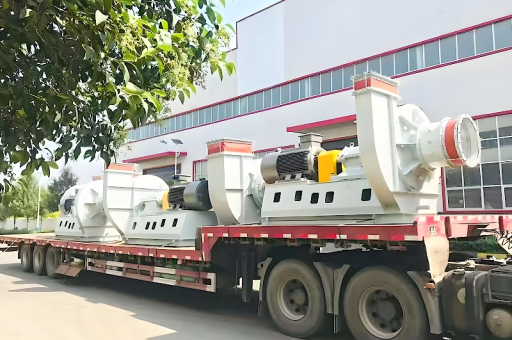
A critical function within this system is the controlled delivery of combustion air. This is not simply “blowing air” into a firebox. It requires precise, high-pressure air that is often pre-heated. The component responsible for this is the hot air forced draft blower fan, frequently implemented as a heavy-duty centrifugal fan. This article provides a deep, technical dive into how these fans operate within a coal-fired steam boiler context, addressing common misconceptions and providing actionable selection and maintenance advice.
Defining the Key Components: Hot Air Forced Draft Blower Fan and Centrifugal Fan
To avoid confusion, let us clearly define the terms used in this system.
- Forced Draft (FD) Fan: This fan is located at the beginning of the air path. It draws ambient air and pushes it through the air pre-heater and then into the boiler furnace. Its “job” is to overcome the resistance of the air path and the furnace pressure.
- Hot Air Blower Fan: In a coal-fired power plant, air is pre-heated using flue gas heat recovery (via an air heater). This “hot air” (often 150°C–350°C) is then injected into the mill or directly into the burner. The fan handling this hot air must be constructed with high-temperature alloys and special bearing cooling systems.
- Centrifugal Fan: This is the mechanical type most often used for forced draft applications. It uses a rotating impeller to increase the velocity of air, and a volute casing to convert that velocity into pressure.
Summary: The specific fan we are discussing is a centrifugal, forced draft blower fan designed to handle hot air for a coal-fired industrial steam boiler.
Why Coal-Fired Boilers Require Specialized Fan Engineering
Unlike gas or oil burners which use simple blowers, coal-fired boilers present a hostile environment for fan operation.
- Abrasion: Pulverized coal and fly ash are highly abrasive. Standard fan blades would erode within weeks.
- Temperature: The air is pre-heated to improve thermal efficiency. Fans that cannot handle 200°C+ air will suffer bearing failure and thermal expansion damage.
- Variable Load: Coal quality varies. The fan must be capable of modulating flow (via VFDs or inlet vanes) to maintain the correct air-to-fuel ratio without surging.
- Pressure Drop: Coal firing requires higher static pressure to push air through the coal pulverizer, the classifier, and into the furnace, which might be operating under positive pressure.
Mechanism of a Forced Draft Fan in a Steam Boiler
The typical flow path is:
Ambient Air → FD Fan → Air Pre-Heater (Hot Side) → Hot Air Duct → Coal Mill / Burner → Furnace.
The forced draft blower fan creates a positive pressure at the inlet of the combustion system. For a coal-fired boiler, this FD fan is often larger than for an oil-fired boiler because it must supply both the primary air (for drying and transporting coal) and the secondary air (for complete combustion).
Key Technical Detail: The fan must deliver a volumetric flow rate that compensates for the high temperature and expansion of the air. A 100,000 CFM fan at 20°C will effectively handle much less mass flow of air at 250°C. Engineers must calculate the actual mass flow of oxygen required, not just the volume.
Centrifugal Fan vs. Axial Fan: Why Centrifugal Wins for Coal Boilers
When selecting a fan for an industrial steam boiler hot air forced draft application, the choice is almost always a centrifugal fan.
| Feature | Centrifugal Fan | Axial Fan |
|---|---|---|
| Pressure Capability | High (10–50 kPa) | Low (0.5–5 kPa) |
| Efficiency at High Pressure | Excellent | Poor |
| Tolerance to Abrasion | High (with thick blades) | Low (blades are thin) |
| Construction | Robust, heavy-duty | Lighter, simpler |
| Suitability for Coal | Excellent | Poor to Marginal |
Why Centrifugal?
The centrifugal fan inherently creates high static pressure. In a coal-fired system, you need this pressure to overcome the resistance of a dirty boiler, ductwork, and the fuel bed. Additionally, centrifugal fans can be built with radial blades (for handling sticky coal dust) or backward-curved blades (for higher efficiency on clean hot air). The rugged design handles thermal expansion better than an axial fan’s close-clearance blades.
Key Performance Parameters: Pressure, Volume, and Temperature
For a proper specification, three variables must be matched to the boiler design.
- Volume Flow Rate (Q): Measured in m³/s or CFM. This must be sufficient to provide the correct excess oxygen (typically 15–25% excess air for coal).
- Static Pressure (P): This is the resistance the fan must overcome. A typical coal-fired boiler FD fan requires 600–1200 mmWG (inches WG). Selecting a fan with too low a pressure leads to “starvation” of the fire; too high causes duct rupture or motor overload.
- Temperature (T): The fan’s impeller and shaft seals must be rated for the maximum hot air temperature. Never assume a standard fan will work. You need a hot air forced draft blower fan with water-cooled bearings or high-temperature grease.
Rule of Thumb: The power required by the fan increases linearly with the flow and pressure. Hot air reduces the density, which actually reduces the power required for the same volume, but the fan must be structurally designed for the thermal stress.
Common Operational Challenges and Troubleshooting Q&A
Here are the most searched questions regarding coal-fired boiler centrifugal fans, answered based on real-world operation.
Q1: Why is my forced draft blower fan vibrating excessively?
- A: This is the most common failure mode. For a coal-fired boiler fan:
- Rotor Imbalance: Coal dust and ash build-up on the impeller blades. This is the #1 cause. The solution is a regular cleaning schedule and installation of an ash hopper under the fan casing.
- Bearing Wear: High temperatures (above 90°C) degrade bearing grease, causing misalignment. Check for water-cooling jacket failure.
- Erosion: Blades may have worn unevenly. Inspect the leading edges.
Q2: How do I handle high inlet air temperature?
- A: The fan must be designated as a hot air unit. Solutions include:
- Using stainless steel (e.g., 310S) or Corten steel impellers.
- Installing a thermal barrier or cooling fan on the drive shaft to prevent heat from traveling to the motor.
- Applying expansion joints between the duct and the fan inlet to absorb thermal growth.
Q3: Can I use a standard centrifugal fan for a coal-fired boiler?
- A: No. Never. A standard fan is built for HVAC or clean air. A coal-fired boiler centrifugal fan requires:
- Heavy duty shaft (larger diameter for stiffness).
- Abrasion-resistant liners (ceramic tiles or welded hard facing).
- Explosion-proof motor (due to coal dust explosion risk).
Q4: How often should I balance the fan?
- A: For continuous operation, we recommend a dynamic field balance every 6 months. If you see vibration velocity exceeding 4.5 mm/s (RMS), it is time for an immediate balance and inspection.
Q5: What does “surging” mean, and how do I stop it?
- A: Surging occurs when the fan operates too close to its low-flow limit. The system (duct, boiler) has more resistance than the fan can overcome. The air flow reverses momentarily, then explodes forward. This causes mechanical shock.
- Fix: Install a recirculation line or use a variable speed drive (VFD) to keep the fan in its stable operating region. Never run a centrifugal fan below 1/3 of its rated flow for the coal-fired boiler application.
Conclusion: Optimizing Efficiency and Lifespan
The industrial steam boiler hot air forced draft blower fan is not a commodity item; it is a precisely engineered component for the harsh environment of coal-fired boiler plants. By selecting a centrifugal fan built from high-temperature, abrasion-resistant materials and by implementing a strict vibration monitoring and cleaning schedule, operators can significantly increase boiler thermal efficiency and reduce unplanned downtime.
For any industrial engineer, remember this: The fan is the lungs of the boiler. If the fan fails, the fire goes out, and the steam stops. Invest in quality, and maintain it with discipline. Always source your replacement fan from a manufacturer specializing in heavy-duty industrial thermal applications—check the specifications for certified high-temperature and heavy-duty coal applications on trusted industrial fan supplier directories.





