
This article's table of contents introduction:
- What is a 4-72 Centrifugal Fan?
- Application: Boiler Suction (Induced Draft - ID Fan)
- The AC Electric Motor
- Typical Specifications (Example)
- Key Considerations for This Application
- Summary
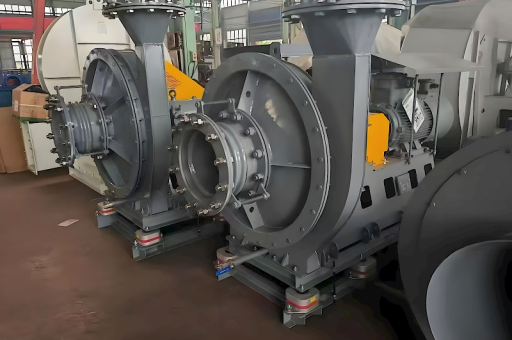
It appears you are looking for information on a 4-72 single inlet centrifugal fan used for boiler suction and driven by an AC electric motor.
This is a very specific and common industrial combination. Here is a breakdown of what this configuration is, its typical specifications, and considerations.
What is a 4-72 Centrifugal Fan?
The "4-72" is a standard Chinese (GB standard) designation for a specific type of centrifugal fan. It has distinct characteristics:
- 4: Indicates the fan is single inlet (air enters from one side).
- 72: Represents the blade exit angle (approx. 72 degrees), making it a forward-curved blade design.
- Type: Backward-inclined or forward-curved? While the series name implies a shape, a "4-72" is almost universally a single-inlet, forward-curved centrifugal fan (often modified or confused in naming, but the 4-72 is the standard "low noise" forward-curved fan in China).
Key Characteristics of the 4-72 Fan:
- High Flow, Medium Pressure: Excellent for moving large volumes of air against moderate resistance (ductwork, boiler heat exchanger).
- Efficient: Designed for relatively high static efficiency compared to older designs.
- Low Noise: Often called the "low noise" centrifugal fan in the Chinese market due to optimized impeller and scroll design.
- Forward-Curved Blades: The blades curve in the direction of rotation. This allows for compact size and high airflow, but they are not as robust as backward-curved blades for dirty or abrasive environments.
Application: Boiler Suction (Induced Draft - ID Fan)
In a boiler system, "suction" means the fan is located after the boiler's heat exchanger and combustion chamber. This is called an Induced Draft (ID) Fan.
Function of an ID Fan:
- It pulls flue gas (hot combustion products) through the boiler, heat exchanger, and chimney.
- It creates negative pressure inside the boiler furnace, preventing hot gas from leaking out into the room.
- It overcomes the pressure drop caused by the boiler's heat exchanger tubes, baffles, and the chimney.
The AC Electric Motor
The fan is driven by a standard AC Induction Motor.
- Power Source: 3-phase, 380V/460V (depending on region), 50Hz/60Hz.
- Connection: Direct drive (coupling) or via V-belts. For boiler ID fans, belt-driven is very common to allow speed adjustments for flow control.
- Motor Type: Standard TEFC (Totally Enclosed Fan Cooled) or, for high-temperature flue gas, a motor with a longer shaft or heat shield.
Typical Specifications (Example)
| Parameter | Typical Value / Range | Notes |
|---|---|---|
| Fan Model | 4-72-№ 3.2A to 20B | Size depends on boiler capacity |
| Flow Rate (Q) | 1,000 m³/h to 500,000 m³/h | Scalable to boiler size |
| Static Pressure (P) | 500 Pa to 4,000 Pa (2" to 16" w.g.) | Medium pressure range |
| Speed | 1450 RPM or 2900 RPM (Direct) / Variable (Belt) | 4-pole or 2-pole motor |
| Temperature | Up to 250°C (482°F) standard | High-temp models: up to 450°C (with shaft cooling) |
| Motor Power | 5 kW to 200 kW | Depends on fan size and duty |
| Drive Type | A (Direct), C (Belt-driven), D (Belt-driven) | Type D is typical for larger ID fans |
Key Considerations for This Application
Since this is a Boiler Suction fan, there are critical operational factors:
- Temperature Rating: The fan must be designed for the flue gas temperature. Standard models handle up to 80-120°C. For boiler ID fans, you need a high-temperature model. This includes:
- Bearings outside the air stream.
- Cooling fan on the motor shaft.
- Expansion joints on the inlet/outlet.
- Material: Standard is carbon steel (Q235/SS400). For corrosive or high-temperature flue gas, you may need:
- Stainless Steel (304/316) for corrosive gas.
- Wear-resistant linings if handling ash.
- Variable Speed Drive (VFD): Using an AC electric motor with a VFD is highly recommended for boiler suction. It allows precise control of the furnace draft, saving energy and reducing system stress.
- Balancing: The impeller must be dynamically balanced, especially for high-speed operation. A poorly balanced ID fan can cause severe vibration and bearing failure.
Summary
| Aspect | Detail |
|---|---|
| Fan Type | 4-72 Single Inlet, Forward-Curved Centrifugal Fan |
| Application | Induced Draft (ID) for boiler flue gas suction |
| Drive | AC Electric Motor (usually 3-phase, 380V/460V) |
| Key Feature | High flow, medium pressure, low noise for boiler systems |
| Critical Need | High-temperature design (bearings, cooling) if for actual boiler flue gas |
If you need a specific selection, please provide:
- Boiler capacity (e.g., 1 ton/hr, 10 MW)
- Flue gas temperature (e.g., 180°C, 250°C)
- Required flow rate (m³/h or CFM)
- Required static pressure (Pa or inches w.g.)
- Motor voltage and frequency (e.g., 380V/50Hz)
Let me know if you need a specific motor selection or control strategy for this fan.





