
This article's table of contents introduction:
- Function in the Cement Plant
- The Wear Problem: Mechanisms
- Wear-Resistant Solutions & Technologies
- Common Failure Modes & Maintenance Strategies
- Industry Best Practices
- Summary Table: Wear Resistance Options
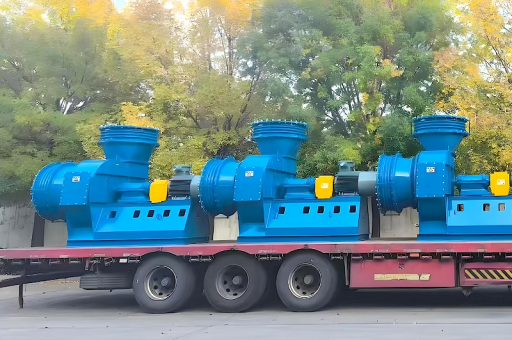
This is a critical piece of equipment in a cement plant. The Raw Material Circulation Fan (often called the Raw Mill Circulation Fan or Preheater Exhaust Fan) handles large volumes of heavily dust-laden gas, making wear resistance its most important design and maintenance feature.
Here is a detailed breakdown of this fan, its challenges, and the typical solutions for wear resistance.
Function in the Cement Plant
This fan is typically located after the Vertical Roller Mill (VRM) or Ball Mill in the raw material grinding circuit. Its primary functions are:
- Gas Transport: To draw hot gases from the preheater or a hot gas generator through the mill.
- Material Lift: To carry the finely ground raw meal (powder) from the mill to the dynamic separator and then to the baghouse/ESP.
- System Draft: To maintain the required negative pressure inside the mill for efficient grinding and drying.
Gas Characteristics:
- High Dust Load: 100 – 500 g/Nm³ (grams per normal cubic meter).
- Abrasive Particles: Quartz, feldspar, limestone, pyrite, and iron particles.
- Temperature: 80°C – 150°C (can be higher during start-up/upset conditions).
- Humidity: Can be high, leading to potential chemical attack.
The Wear Problem: Mechanisms
The primary enemy is erosive wear caused by high-velocity solid particles impacting the fan blades and casing.
- Erosion Type: Abrasive and impact erosion.
- Wear Pattern:
- Blade Leading Edge: The most severe area as it strikes the gas stream first.
- Blade Concave Surface (Pressure Side): Particles slide along this surface, causing "scouring" wear.
- Blade Trailing Edge: Can also suffer wear, especially if the flow is uneven.
- Casing (Scroll): The "cutwater" (where the casing narrows) and the area near the fan outlet are highly susceptible.
- Consequences of Wear:
- Loss of aerodynamic efficiency (higher power consumption).
- Increased vibration (unbalanced rotor).
- Reduced fan life (catastrophic failure or excessive maintenance downtime).
- Impeller imbalance (creates bearing and shaft wear).
Wear-Resistant Solutions & Technologies
Engineers use a multi-layered approach based on the severity of the wear.
A. Blade Design & Geometry
- Thickened Leading Edge: Blades are cast or fabricated with a significantly thicker leading edge to provide a sacrificial wear layer.
- Optimized Blade Profile: Using backward-curved airfoil blades instead of radial or forward-curved blades. This reduces particle impact velocity against the blade surface.
- Wear Plates (Replaceable): The leading edge and pressure side are fitted with bolted or welded sacrificial plates made of high-chrome white iron (e.g., 25% Cr) or sintered carbide. This allows for quick replacement without removing the entire impeller.
B. Surface Upgrades (Coatings & Cladding)
- Hardfacing / Weld Overlay: Applying a layer of tungsten carbide or high-chrome iron alloy via welding (manual or automatic) onto the blade surface. This is the most common field-repair technique.
- Ceramic Lining (Tile or Paste):
- Ceramic Tiles: High-purity alumina (92-99%) tiles bonded with a high-temperature epoxy or welded with steel studs. Extremely hard and long-lasting.
- Ceramic Putty / Epoxy: A trowelable or brushable paste loaded with ceramic beads (alumina, zirconia). Good for complex geometries or patching.
- Spray Coatings: HVOF (High-Velocity Oxy-Fuel) or plasma sprayed coatings of tungsten carbide-cobalt (WC-Co) or chromium carbide. Very dense and hard, but expensive and requires specialized application.
C. Base Material Selection
- High-Chrome White Iron: Used for cast impellers. Excellent abrasion resistance but is brittle (cannot handle significant thermal shock).
- Duplex Stainless Steel (e.g., 2205): Good corrosion resistance combined with high strength, often used as a base before hardfacing.
- Abrasion-Resistant Steel (e.g., AR400, AR500): Common for fabricated casings and non-critical parts.
D. Downstream or Inlet Modifications
- Pre-Separators / Dust Collectors: Installing a cyclone or gravity settling chamber upstream of the fan can remove the largest, most abrasive particles. This drastically extends fan life.
- Inlet Box Liner: The inlet box is lined with thick replaceable abrasion-resistant steel or ceramic.
Common Failure Modes & Maintenance Strategies
| Failure Mode | Typical Cause | Solution |
|---|---|---|
| Blade Holes | Severe localized erosion | Ceramic tile patch, weld overlay build-up. |
| Impeller Crack | Fatigue from residual stress & vibration due to uneven wear. | NDT inspection (Magnetic Particle or Dye Penetrant). Re-balancing after weld repair. |
| Casing Wear | Particle flow against the volute shell. | Ceramic-lined replaceable wear pads inside the casing. |
| Shaft Seal Wear | Dust ingress due to high pressure. | Upgraded labyrinth seals or carbon ring seals with purge air. |
Industry Best Practices
- Pre-Filtration: If the raw material contains >5% quartz or very coarse particles, always consider a pre-separator (e.g., a simple drop-out box) before the fan.
- Inspection Schedule: Every 1-2 months, perform a visual inspection via manholes. Use a borescope to check blade condition without opening.
- Vibration Monitoring: Install permanent vibration sensors (accelerometers) on bearing housings. A sharp rise in vibration amplitude (especially 1x RPM) often indicates blade wear or imbalance.
- Balancing: After any hardfacing repair, the impeller must be dynamically re-balanced. A few grams of imbalance can destroy bearings in hours.
- Temperature Management: Avoid extreme temperature fluctuations during start-up to prevent thermal cracking of brittle hardfacing or ceramics.
Summary Table: Wear Resistance Options
| Feature | Technology | Pros | Cons |
|---|---|---|---|
| Blade Leading Edge | Tungsten Carbide Hardfacing | Very hard, field-repairable | Can crack under thermal shock. |
| Pressure Side | Ceramic Tile Lining | Extremely long life (3-5x vs steel). | Expensive, can pop off if adhesive fails. Heavy. |
| Casing | High-Chrome White Iron | Inherently abrasion resistant. | Brittle, difficult to weld repair. |
| Full Surface | HVOF WC-Co Coating | Dense, smooth finish (efficiency). | High cost, requires specialized equipment. |
Bottom Line for a Cement Plant: For a Raw Material Circulation Fan, the most effective and cost-efficient long-term solution is typically a fabricated impeller with replaceable high-chrome wear plates on the leading edge and pressure side, combined with ceramic tile patches on the casing cutwater and the highest-erosion zones. Regular, scheduled inspection and immediate repair of small wear spots is cheaper than a catastrophic failure.





