
** The Critical Role of Electric Backward Curved Blowers in Modern Calcining Kiln Operations: Efficiency, Reliability, and Performance Optimization
Article Content
Table of Contents
- Introduction: Why Blower Selection Matters in Calcining Kilns
- Understanding the Electric Backward Curved Blower Design
- Key Advantages Over Forward Curved and Radial Blowers
- How Backward Curved Blowers Enhance Calcining Kiln Performance
- Common Technical Questions and Expert Answers
- Selection Criteria for Calcining Kiln Applications
- Maintenance Best Practices for Long Service Life
- Conclusion: Future Trends in Kiln Air Movement Technology
Introduction: Why Blower Selection Matters in Calcining Kilns
In high-temperature industrial processes such as calcining, where materials like limestone, gypsum, or petroleum coke are thermally decomposed, the air movement system is not an auxiliary component—it is a core performance driver. The Electric Backward Curved Blower For Calcining Kilns has emerged as a preferred solution due to its ability to handle variable airflow demands, resist particulate buildup, and maintain high static pressure efficiency. Unlike traditional fans that waste energy at partial loads, backward curved impellers deliver stable performance across a wide operating range. This article examines why this technology is indispensable for modern calcining operations, and how it directly impacts fuel consumption, product quality, and equipment longevity.
Understanding the Electric Backward Curved Blower Design
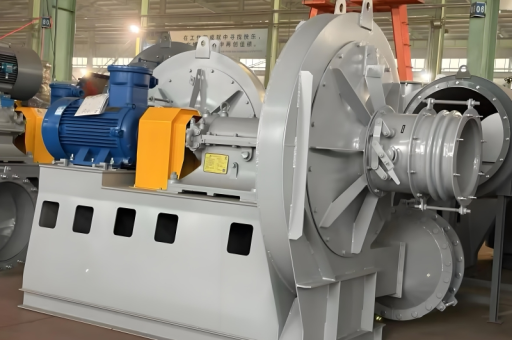
A backward curved blower is defined by its blade geometry: the blades curve away from the direction of rotation. This design creates a centrifugal force that accelerates air radially outward, generating high pressure with relatively low noise. The electric motor is directly coupled or belt-driven, allowing precise speed control via Variable Frequency Drives (VFDs). The impeller is typically constructed from abrasion-resistant steel or, for corrosive flue gases, coated with anti-corrosion materials. The key engineering characteristic is that the power curve reaches a peak and then declines, which prevents motor overload—a critical safety feature for kilns where duct resistance fluctuates.
Key Advantages Over Forward Curved and Radial Blowers
When comparing blower types for calcining kilns, the backward curved design offers three distinct advantages:
- Non-Overloading Power Characteristic: Forward curved and radial blowers can draw excessive amperage if the system pressure drops, risking motor burnout. The backward curved blower actually reduces power consumption as system resistance decreases, protecting the drive train.
- High Static Pressure Efficiency: Typical efficiencies for backward curved models range from 75% to 85%, significantly higher than forward curved (50–65%) or radial (60–70%) blowers. In a 500 HP kiln air system, this translates to annual electricity savings of $20,000–$50,000.
- Resistance to Fouling: The blade shape discourages the adhesion of dust and calcined fines. Even when particulate buildup occurs, the centrifugal force tends to self-clean the blades, reducing maintenance downtime.
How Backward Curved Blowers Enhance Calcining Kiln Performance
In a calcining kiln, the blower must deliver combustion air to the burner, provide cooling air for the shell, and sometimes convey pulverized fuel. The Electric Backward Curved Blower For Calcining Kilns excels in these tasks:
- Stable Air/Fuel Ratio Control: Precise airflow modulation via VFD ensures optimal combustion, reducing excess oxygen and lowering NOx emissions.
- Adaptability to Kiln Draft Variations: As the kiln rotates and charge depth changes, system resistance fluctuates. The backward curved blower responds without surging or stalling—a common problem with forward curved designs.
- Extended Bearing and Motor Life: Because operating current stays within a safe window, thermal stress on windings and bearings is minimized. Many operators report 50% longer bearing replacement intervals compared to radial blowers.
Common Technical Questions and Expert Answers
Q1: Can a backward curved blower handle high-temperature flue gases from the kiln? A: Yes, but with limitations. Standard models can handle up to 80°C (176°F). For direct flue gas extraction (typically 200–350°C), the impeller must be made of heat-resistant alloys (e.g., 316L stainless steel or Inconel) and the shaft cooling system must be upgraded. Always consult the manufacturer’s temperature derating curve.
Q2: Is the blower suitable for both forced draft (FD) and induced draft (ID) applications? A: Absolutely. For FD (pushing air into the kiln), standard construction suffices. For ID (pulling gases out), the blower must be sealed to prevent air leakage and fitted with a drain to handle condensation. A backward curved ID fan is particularly effective because its flat pressure curve maintains draft stability.
Q3: How does the blower perform at variable speeds? A: Backward curved blowers follow the affinity laws: airflow is proportional to speed, pressure to speed squared, and power to speed cubed. This makes them ideal partners for VFDs. However, at very low speeds (<20%), the impeller may become unstable. A minimum speed controller is recommended.
Selection Criteria for Calcining Kiln Applications
When specifying an Electric Backward Curved Blower For Calcining Kilns, engineers should evaluate:
- Required Airflow (CFM) and Static Pressure (in. w.g.): These are determined by the kiln’s heat balance. Oversizing wastes energy; undersizing reduces production.
- Gas Composition and Temperature: If the gas contains sulfur or chlorides, the blower must have corrosion-resistant coatings (e.g., epoxy or rubber lining).
- Drive Configuration: Direct drive eliminates belt maintenance but limits speed flexibility. Belt drive allows easy pulley changes but reduces mechanical efficiency by 2–5%.
- Space Constraints: Backward curved blowers are generally more compact than radial types, but the inlet and outlet duct transitions must be smooth to avoid turbulence.
Pro Tip: Always request a performance curve from the manufacturer. The curve should show a clear flow rate at the “best efficiency point” (BEP). Operating the blower within 70–100% of BEP maximizes life.
Maintenance Best Practices for Long Service Life
- Routine Vibration Analysis: Impeller imbalance from dust buildup is the most common failure. Install accelerometers on the bearing housings and trend velocity data monthly.
- Bearing Greasing Schedule: Use high-temperature grease (NLGI Grade 2) and re-lubricate every 500 operating hours. Over-greasing causes overheating.
- Belt Tension Inspection: For belt-driven units, check tension with a belt tension gauge. Loose belts cause slippage and reduce airflow.
- Impeller Cleaning: Even with self-cleaning design, inspect the impeller quarterly. Use compressed air or soft brushes—never steel scrapers, which damage the blade profile.
Conclusion: Future Trends in Kiln Air Movement Technology
The industrial calcining sector is moving toward higher energy efficiency and lower emissions. The Electric Backward Curved Blower For Calcining Kilns is at the center of this transformation. Manufacturers are now integrating IoT sensors directly into the blower housing, enabling real-time monitoring of bearing temperature, vibration, and motor current. Predictive maintenance algorithms can alert operators to potential failure weeks before occurrence. Furthermore, new aerodynamic blade designs (e.g., backward curved with airfoil profiles) are pushing efficiency beyond 90%. As environmental regulations tighten, the backward curved blower’s ability to operate precisely at the exact combustion air setpoint—without excess—makes it not just a component, but a strategic asset for any kiln operator seeking to reduce carbon footprint and operating costs.
For those seeking to upgrade their kiln’s air system, remember: the fan is the lungs of your process. Choose a blower that breathes efficiently, reliably, and intelligently.
End of Article





