
This article's table of contents introduction:
- Article Directory
- Introduction: The Backbone of Smelting Ventilation
- Understanding the Terminology: ID Fan vs. Forced Draft Fan
- The Smelting Industries Standard: Why Compliance Matters
- Deep Dive: The Y6-51 Induced Draft Fan Blower – Design, Features, and Performance
- Key Application Areas: From Copper Smelting to Steelmaking
- How to Select the Correct Y6-51 ID Fan for Your Facility
- Maintenance Best Practices for Longevity and Efficiency
- Frequently Asked Questions (FAQ)
- Conclusion: Why the Y6-51 Remains the Industry Benchmark
*The Critical Role of the Y6-51 Smelting Industries Standard Induced Draft Fan (ID Fan Blower) in Modern Metallurgical Processes*
Article Directory
- Introduction: The Backbone of Smelting Ventilation
- Understanding the Terminology: ID Fan vs. Forced Draft Fan
- The Smelting Industries Standard: Why Compliance Matters
- Deep Dive: The Y6-51 Induced Draft Fan Blower – Design, Features, and Performance
- Key Application Areas: From Copper Smelting to Steelmaking
- How to Select the Correct Y6-51 ID Fan for Your Facility
- Maintenance Best Practices for Longevity and Efficiency
- Frequently Asked Questions (FAQ)
- Conclusion: Why the Y6-51 Remains the Industry Benchmark
Introduction: The Backbone of Smelting Ventilation
In the aggressive, high-temperature environment of a smelting plant, the atmosphere is laden with corrosive gases, particulate matter, and extreme heat. Without a robust ventilation system, these conditions would render operations impossible and deadly. At the heart of this system lies the Induced Draft Fan (ID Fan), often referred to generically as an ID Fan Blower. However, not all fans are created equal. For facilities adhering to the Smelting Industries Standard, the Y6-51 series has emerged as the definitive choice. This article explores why this specific fan is non-negotiable for heavy-duty metallurgical applications, integrating technical specifics, compliance requirements, and practical operational insights.
Understanding the Terminology: ID Fan vs. Forced Draft Fan
To appreciate the Y6-51, one must first understand the difference between an Induced Draft (ID) fan and a Forced Draft (FD) fan.
- Forced Draft (FD) Fan: Located at the inlet of the system. It pushes fresh air into the furnace or combustion chamber. It operates under positive pressure and typically handles cleaner, cooler air.
- Induced Draft (ID) Fan: Located at the outlet of the system (between the dust collector and the chimney). It pulls (induces) flue gases from the furnace through the pollution control equipment. It operates under negative pressure and handles hot, abrasive, and corrosive gases.
The Y6-51 ID Fan Blower is specifically designed for the latter, most challenging role. It must endure thermal expansion, erosion from fly ash, and the chemical attack of sulfur dioxide (SO2) and nitrogen oxides (NOx).
The Smelting Industries Standard: Why Compliance Matters
"Smelting Industries Standard" is not a generic label; it refers to a specific set of engineering benchmarks (often derived from international codes like ISO or Chinese GB standards for heavy industries) that govern fan performance in metallurgy.
Key requirements include:
- High-Temperature Resistance: The fan must operate continuously at gas temperatures often exceeding 250°C (482°F), with peak tolerances up to 400°C.
- Structural Integrity: The casing and impeller must withstand thermal stress without warping.
- Leakage Prevention: Seals must prevent gas leaks to protect workers and the environment.
- Vibration Control: Extreme balance grade (e.g., G2.5 or better) is mandated to prevent catastrophic failure at high RPMs.
The Y6-51 was engineered to meet these exacting specifications, making it the "standard" equipment for compliance auditors.
Deep Dive: The Y6-51 Induced Draft Fan Blower – Design, Features, and Performance
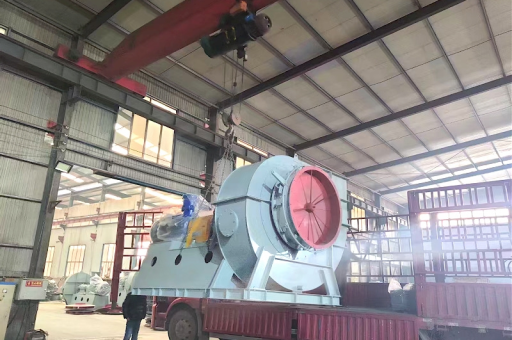
The Y6-51 fan (Type: Y6-51) is a single-inlet, overhung-style centrifugal fan with backward-curved blades. Here is a technical breakdown of why it performs so well in smelting applications:
- Impeller Design: The backward-inclined blades (similar to airfoil design) are highly efficient (typically 82-85% peak). They are made of wear-resistant 16Mn steel or Q345R boiler plate to resist erosion. The streamlined flow path minimizes turbulence, reducing energy consumption.
- Casing Construction: The casing is spiral-shaped with a wear liner. It is designed to be split horizontally, allowing for easy impeller replacement without removing the entire fan from the ductwork.
- Shaft and Bearings: The shaft is oversized to reduce deflection under heavy loads. Most Y6-51 units use rolling bearings with forced lubrication or cooling fans to dissipate heat radiated through the shaft.
- Capacity & Pressure: The Y6-51 series typically offers a flow range of 6,700 to 200,000 m³/h and a total pressure range of 1,500 to 6,000 Pa, making it ideal for the moderate static pressure requirements combined with high volume needs of a smelter.
Performance Curve Analysis: The characteristic curve of the Y6-51 is "steep," meaning that a large change in system resistance (e.g., a clogged baghouse filter) results in only a moderate change in flow. This "non-overloading" power characteristic prevents the motor from burning out when the system back-pressure changes.
Key Application Areas: From Copper Smelting to Steelmaking
The Y6-51 ID fan is ubiquitous across various smelting sub-sectors:
- Steel Smelters (Converter & EAF): Extracts fumes from the Basic Oxygen Furnace (BOF) or Electric Arc Furnace (EAF). These gases contain high levels of CO and iron oxide dust.
- Copper Smelters (Flash Smelting): Handles SO2-rich gases destined for sulfuric acid plants. The fan must be absolutely leak-tight (often using advanced shaft seals) to prevent acid gas escape.
- Zinc/Lead Smelters: Manages fumes from sintering machines and blast furnaces, which contain volatile heavy metals.
- Ferroalloy Production: Withstands the extreme abrasion of silicon and manganese dust.
A real-world case study: A copper smelter in Chile upgraded from a standard fan to the Y6-51 and saw a 15% reduction in electricity costs due to improved aerodynamic efficiency, while extending the maintenance interval from 6 months to 14 months.
How to Select the Correct Y6-51 ID Fan for Your Facility
Selecting an ID fan blower is not a one-size-fits-all process. Here is the standard selection procedure:
- Define Gas Conditions: Measure temperature, density, and moisture content of the flue gas at the fan inlet.
- Set Pressure Requirements: Calculate the total resistance of the ductwork, dust collector, and chimney, factoring in a safety margin (usually 10-15%).
- Volume Calculation: The required flow (m³/h) must account for infiltration air and barometric pressure at the facility's altitude.
- Impeller Size and Speed: Using the Y6-51 performance curves, select the impeller diameter (e.g., No. 5 through No. 31.5) and RPM that hits the operating point near the peak efficiency island.
- Material Selection: For high sulfur content, upgrade to stainless steel (316L) or apply a ceramic coating to the blades.
- Variable Speed Drive (VFD): The Y6-51 is ideally paired with a VFD to allow precise control of draft pressure, saving 20-30% energy compared to damper control.
Maintenance Best Practices for Longevity and Efficiency
A neglected Y6-51 ID fan blower will fail quickly. Here is a checklist for reliability:
- Periodic Vibration Monitoring: Check bearing housing vibration monthly (max 4.6 mm/s RMS). A sudden spike indicates impeller imbalance or bearing wear.
- Bearing Temperature Tracking: Use thermal cameras. Temperatures above 85°C (185°F) signal lubrication failure or misalignment.
- Internal Inspection: Every 6 months, open the inspection door to check for dust accumulation on the blades. Uneven buildup causes imbalance.
- Shaft Seal Integrity: Inspect the labyrinth seals or carbon ring seals for wear. Leaks here waste energy and are a safety hazard.
- Impeller Wear Check: Measure blade thickness at the leading edge. Replace the impeller when thickness is reduced by 50%.
Frequently Asked Questions (FAQ)
Q1: What is the difference between a Y6-51 fan and a Y5-47 fan? A: The Y5-47 is an older generation fan with radial blades designed for lower efficiency and higher dust handling tolerance. The Y6-51 uses backward-curved blades, offering higher efficiency (82%+) and quieter operation, though it is slightly more sensitive to dust buildup.
Q2: Can the Y6-51 ID Fan be used for a cement plant? A: Yes, but with modifications. While it is a metallurgical fan, the same high-temperature and abrasion resistance makes it suitable for cement kiln exhaust, although specific cement industry fans (like the M6-31) are more common.
Q3: Why does my Y6-51 fan vibrate after cold start? A: This is "thermal imbalance." The shaft and impeller heat up at different rates. Let the fan run at a low speed (20% load) for 10-15 minutes to warm up evenly before ramping to full speed.
Q4: How tight should the inlet damper be set? A: For starting the Y6-51 blower, the inlet damper must be closed to reduce starting current. Open it gradually once the motor reaches full speed.
Q5: What material is standard for the Y6-51 impeller? A: The standard material is 16Mn (Q345) steel. For corrosive environments, 304 or 316 stainless steel is recommended.
Conclusion: Why the Y6-51 Remains the Industry Benchmark
The Smelting Industries Standard Induced Draft Fan (Y6-51) is not merely a component; it is the sentinel of the plant's exhaust system. Its backward-curved blade design, adherence to strict metallurgical codes, and proven durability in handling corrosive, high-temperature gases make it indispensable. By understanding its design, proper selection, and maintenance, engineers can ensure not only compliance with industry standards but also significant operational cost savings through high efficiency.
For any smelting operation seeking reliability in harsh conditions, the Y6-51 ID fan blower remains the definitive, standard-driven solution. When sourcing, always verify the impeller balance grade and material certification with the manufacturer. The right fan, installed with a VFD and maintained with rigorous vibration checks, will deliver a decade or more of continuous, safe service.





