
This article's table of contents introduction:
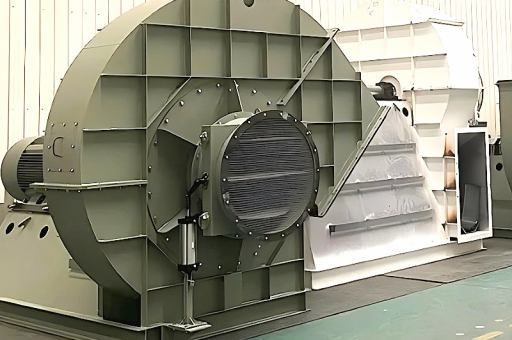
- What is the Y5-47 Centrifugal Fan?
- Why "High Efficiency & Low Noise"?
- Key Features & Specifications
- Common Applications (Where you will find this fan)
- Advantages of the Y5-47 Fan
- Disadvantages & Limitations
- Installation & Maintenance Notes
- Summary
It appears you are referencing the Y5-47 type centrifugal fan, which is a specific model widely used in industrial boiler systems, particularly for induced draft (exhaust) applications.
Here is a detailed breakdown of the Y5-47 fan, focusing on its "High Efficiency" and "Low Noise" characteristics, as well as its standard specifications and applications.
What is the Y5-47 Centrifugal Fan?
The Y5-47 is a single-inlet, single-suction centrifugal fan designed specifically for boiler induced draft systems. Its key design features are its forward-curved blades and a reinforced housing to handle high temperatures and slightly corrosive flue gases.
Why "High Efficiency & Low Noise"?
The Y5-47's design strikes a balance between performance and acoustics:
- Forward-Curved Blades: The fan uses forward-curved blades (curved in the direction of rotation). This design allows for high air volume (flow rate) at relatively lower speeds compared to backward-curved fans.
- Benefit: Lower speed directly translates to lower mechanical and aerodynamic noise.
- Optimized Aerodynamic Design: The volute (spiral housing) and impeller inlet are designed to minimize turbulence and vortex formation. Smoother airflow means less energy is lost to friction and noise (loud whooshing or roaring sounds).
- Stable Performance Curve: The fan has a stable pressure curve, meaning it can handle fluctuations in boiler backpressure without surging excessively. This stable operation reduces the vibration and low-frequency rumble that causes structural noise.
Key Features & Specifications
| Feature | Specification / Detail |
|---|---|
| Type | Centrifugal, Single Inlet, Forward-Curved Blade |
| Application | Boiler Induced Draft (ID Fan) |
| Medium | Flue gas (air mixed with combustion byproducts) |
| Max. Medium Temp | Typically ≤ 250°C (482°F) . High-temperature variants exist. |
| Drive Types | Direct Drive (D) or Belt Drive (C or E type) |
| Impeller Direction | Left or Right rotation (viewed from motor side) |
| Discharge Angle | Customizable (e.g., 0°, 45°, 90°, 135°, 180°, 225°) |
| Efficiency | Typically 70% - 82% depending on operating point |
| Noise Level | Typically 75 - 85 dB(A) (varies with speed and size, but quieter than older models like the Y5-47s predecessor) |
Common Applications (Where you will find this fan)
- Coal-Fired Boilers: Small to medium industrial boilers.
- Biomass Boilers: Handling dusty or slightly corrosive flue gas.
- Oil/Gas Boilers: For exhaust.
- Industrial Furnaces & Kilns: For draft control.
- Dust Collection Systems: (In some cases, when used as an exhaust fan for non-abrasive dust).
Advantages of the Y5-47 Fan
- Low Noise Operation: As highlighted, the forward-curved blade design at lower RPM makes it significantly quieter than many other industrial fan types.
- Compact Size: The impeller and housing are relatively compact for the air volume they move.
- Cost-Effective: Simpler construction and lower manufacturing costs compared to high-efficiency backward-curved airfoil fans.
- Self-Cleaning (Moderate): The forward-curved design is less prone to dust buildup compared to airfoil blades, though not as resilient as radial blades.
Disadvantages & Limitations
- Lower Peak Efficiency: While "high efficiency" for its class, the Y5-47 (forward-curved) is typically 5-10% less efficient at its best operating point than a modern backward-curved airfoil fan (e.g., Y5-48 or 9-19 types).
- Overloading Risk: Forward-curved fans have a rising power characteristic. If the system pressure drops unexpectedly (e.g., a duct collapses), the motor power draw increases significantly, risking motor burnout. This requires careful motor sizing and protection.
- Not for Abrasive Dust: Forward-curved blades are susceptible to rapid wear if the gas contains high levels of sharp, abrasive particles (e.g., sand, fly ash from high-ash coal).
Installation & Maintenance Notes
- Vibration Monitoring: Regular checks are vital. Unbalanced impellers (due to dust buildup or wear) cause significant noise and damage.
- Bearing Cooling: For high-temperature applications, bearings often have cooling fins or a cooling water jacket.
- Duct Connection: Use a flexible connector at the fan inlet/outlet to prevent vibration transmission into the ductwork (which amplifies noise).
- Variable Frequency Drive (VFD): The noise level and efficiency can be greatly improved by running the fan at the minimum required speed using a VFD, rather than throttling with a damper.
Summary
The Y5-47 fan is a reliable, high-volume, low-to-medium pressure booster fan optimized for quieter operation than other draft fan types. It is a common choice for smaller boiler rooms where noise pollution is a concern but the very highest efficiency ( >85%) is not the absolute priority.
If you need even higher efficiency or are handling abrasive dust, you would likely look at the Y5-48 (backward-curved, higher efficiency) or Y9-26 (radial blade, wear-resistant) types.





