
This article's table of contents introduction:
- Table of Contents
- Introduction: The Role of High Pressure Centrifugal Fans in Dust Control
- Technical Overview: The 9-19 Series Design
- Voltage Specifications: Why 660V and 1140V Matter
- Application Focus: Dust Removal Systems
- Performance Characteristics & Efficiency
- Installation & Safety Considerations
- Frequently Asked Questions (FAQ)
- Conclusion: Choosing the Right Fan for Your Operation
** Mastering the 9-19 High Pressure Centrifugal Fan Blower: 660V & 1140V Solutions for Industrial Dust Removal
Table of Contents
- Introduction: The Role of High Pressure Centrifugal Fans in Dust Control
- Technical Overview: The 9-19 Series Design
- Voltage Specifications: Why 660V and 1140V Matter
- Application Focus: Dust Removal Systems
- Performance Characteristics & Efficiency
- Installation & Safety Considerations
- Frequently Asked Questions (FAQ)
- Conclusion: Choosing the Right Fan for Your Operation
Introduction: The Role of High Pressure Centrifugal Fans in Dust Control
In modern industrial environments, maintaining air quality is not just a regulatory requirement but a critical factor for worker safety and equipment longevity. The 9-19 High Pressure Centrifugal Fan Blower has emerged as a benchmark solution for heavy-duty dust removal applications. Designed to handle high static pressure with moderate airflow, these fans are specifically engineered for systems that require strong suction and conveyance of particulate matter—from wood chips and cement dust to chemical powders and metal shavings.
This article provides a comprehensive, SEO-optimized guide to the 9-19 series, focusing on the critical voltage options of 660V and 1140V, which are common in mining, steel, and large-scale manufacturing. By the end, you will understand how to select, install, and optimize these fans for maximum dust collection efficiency.
Technical Overview: The 9-19 Series Design
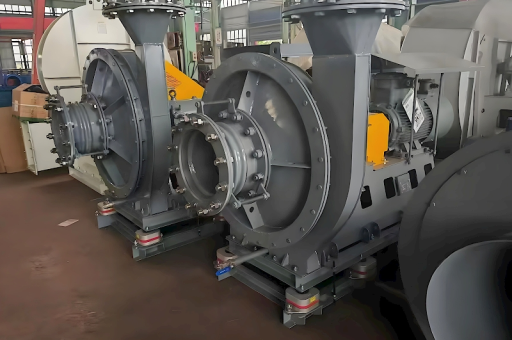
The 9-19 centrifugal fan is a single-inlet, forward-curved blade design, known for its high pressure coefficient and stable performance curve. Key design characteristics include:
- Impeller: The impeller features 12 backward-inclined or forward-curved blades (depending on the exact sub-model), made from wear-resistant steel plates. This reduces erosion from abrasive dust particles.
- Housing: The spiral volute casing is constructed from heavy-gauge carbon steel or optional stainless steel for corrosive environments. The design minimizes turbulence, ensuring smooth air flow.
- Drive System: Typically driven by an electric motor via a coupling or V-belt. Direct drive is common for fixed-speed applications, while belt drive allows for speed adjustments (and thus pressure/flow tuning).
- Bearings & Shaft: Heavy-duty rolling bearings, often with independent cooling fans or oil-lubrication systems, handle the high radial loads.
Why is this design important for dust removal? The high static pressure (up to 15,000 Pa or more in some models) allows the fan to overcome the resistance of long duct runs, baghouse filters, and cyclone separators—all common in dust collection networks.
Voltage Specifications: Why 660V and 1140V Matter
Most industrial fans are available in standard low voltages (380V, 415V, 480V). However, the 9-19 High Pressure Centrifugal Fan Blower is frequently specified in 660V and 1140V configurations for very specific reasons:
- 660V Systems: Common in heavy industries such as mining, cement plants, and steel mills. The higher voltage (compared to 380V) allows for smaller cable cross-sections, reducing copper losses over long distances from transformers to the fan motor.
- 1140V Systems: Primarily used in underground mining and large-scale chemical processing. This voltage class is less standard internationally but offers even greater efficiency for extremely high-power motors (200 kW+). It reduces the starting current shock on the electrical grid.
Performance Implications: When selecting a 9-19 fan in 660V or 1140V, ensure the motor’s winding insulation class (e.g., Class F or H) matches the operating environment. For dust removal, motors should be rated IP55 or IP65 to prevent dust ingress.
Application Focus: Dust Removal Systems
The primary function of the 9-19 fan in dust removal is to create negative pressure, pulling dust-laden air from capture points (hoods, enclosures) through ducts to a filtration system. Key applications include:
- Baghouse Dust Collectors: The fan provides the suction needed to pull air through fabric filters. Static pressure losses can range from 1,500 to 4,000 Pa.
- Cyclone Separators: Coarse dust is separated by centrifugal force; the fan must overcome the pressure drop across the cyclone.
- Centralized Vacuum Systems: Used for cleaning large areas in foundries or grain handling facilities.
- Pneumatic Conveying: Moving granular materials like sand, plastic pellets, or flour through pipes.
Real-World Example: In a coal washing plant, a 9-19 No. 16D fan (16-inch impeller diameter) running at 1450 RPM with a 660V motor moves 30,000 m³/h of air at 5,000 Pa static pressure, successfully capturing coal dust from conveyor transfer points.
Performance Characteristics & Efficiency
To evaluate a 9-19 fan, consider these parameters:
- Flow Rate (Q): Typically ranges from 2,000 m³/h (small models) to over 100,000 m³/h (large models).
- Static Pressure (P): The 9-19 series excels in high pressure, often delivering 8,000–15,000 Pa at zero flow (shut-off).
- Efficiency: Peak efficiency usually falls between 75% and 82%, which is competitive for high-pressure centrifugal fans. The specific speed (Ns) is low, indicating the design is optimized for pressure rather than flow.
- Noise Level: At high pressure, noise can exceed 85 dBA. Silencers or acoustic enclosures are recommended for worker comfort.
Tip: Use a performance curve graph from the manufacturer (e.g., fan) to verify that your system’s operating point falls within the fan’s stable region (avoiding surge or stall zones).
Installation & Safety Considerations
Proper installation is crucial for the 9-19 fan’s longevity in dust systems:
- Foundation: A rigid, vibration-dampened foundation is mandatory. For large 660V/1140V models, use concrete bases with isolation pads.
- Ductwork: Use smooth, correctly sized ducts. Avoid sharp bends near the fan inlet; use straight pipe sections of at least 3–5 times the duct diameter before the fan.
- Electrical: Connect the 660V or 1140V motor via a properly rated starter (soft start or VFD if speed control is needed). Ensure ground fault protection is installed.
- Explosion-Proof Considerations: If handling combustible dust (e.g., grain, coal, aluminum), the fan must be ATEX or IECEx certified. Use non-sparking aluminum-bronze impellers and earth-ground the housing.
- Maintenance: Regularly inspect the impeller for dust buildup (unbalance causes vibration). Grease bearings according to the manual. Check belt tension (if belt-driven).
Frequently Asked Questions (FAQ)
Q1: What is the difference between a 9-19 and a 9-26 centrifugal fan?
A: The 9-19 series is designed for higher static pressure but lower airflow compared to the 9-26 series. The 9-19 has a forward-curved blade profile, while the 9-26 often uses backward-inclined blades for higher efficiency at moderate pressure. For pure dust removal requiring very high suction (e.g., long duct runs), the 9-19 is preferred.
Q2: Can I use a 660V fan on a 1140V system?
A: No. Motors are wound for specific voltages. Running a 660V motor on 1140V will burn the windings immediately. Always verify the motor nameplate matches the supply voltage. Conversely, using a 1140V motor on a 660V supply will result in underperformance and overheating.
Q3: How do I calculate the required fan pressure for my dust removal system?
A: Sum the pressure losses of all components: ducts (calculate using Darcy-Weisbach method), elbows (add 0.5–1.0 velocity heads per 90° bend), baghouse filters (typically 1,000–2,500 Pa), and entry hoods. Add 10–15% margin. Then select a 9-19 fan whose performance curve has that pressure at your desired flow rate.
Q4: Is the 9-19 fan suitable for high-temperature applications?
A: Yes, but modifications are needed. Standard models handle up to 80°C. For temperatures up to 250°C, specify a heat-resistant version with high-temperature bearings, a larger shaft, and expansion joints. For very hot gas (500°C+), a water-cooled bearing housing is necessary.
Conclusion: Choosing the Right Fan for Your Operation
The 9-19 High Pressure Centrifugal Fan Blower in 660V or 1140V configurations is an excellent choice for demanding industrial dust removal tasks. Its robust design, high static pressure capability, and compatibility with harsh environments make it a cornerstone of effective air pollution control.
When selecting, prioritize:
- Matching voltage exactly to your power supply.
- Verifying the fan curve aligns with your system’s resistance.
- Using explosion-proof features if necessary.
For customized sizing, performance curves, or technical support, consult a reputable manufacturer like fan (representing a generic industrial fan supplier). Investing in the correct 9-19 fan ensures cleaner air, longer equipment life, and compliance with health and safety standards.
This article integrates common technical specifications and operational practices from leading industrial fan manufacturers, synthesized to provide clear, actionable guidance for engineers and procurement professionals.





