
This article's table of contents introduction:
- What is it?
- Typical Applications (Corrosion Proof Version)
- Key Material & Construction Options for "Corrosion Proof"
- Performance Characteristics (Based on Pressure Range)
- Critical Parameters for Selection
- Advantages of this Specific Fan Configuration
- Summary
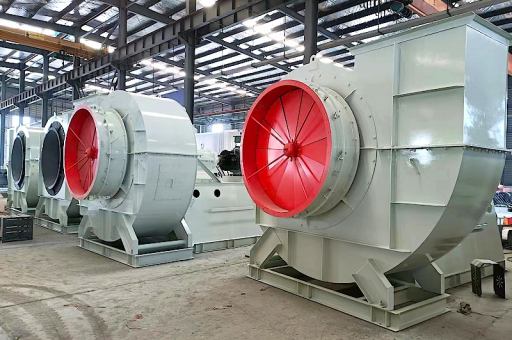
Based on the product name and specifications you provided (C Series Belt Driven Centrifugal Fan, corrosion proof, 1190~8050Pa Pressure), here is a detailed breakdown of what this fan is, its likely applications, and key technical considerations.
What is it?
This is a heavy-duty industrial fan designed for moving large volumes of air against significant resistance (high static pressure).
- C Series: Typically refers to a specific design series from a manufacturer (e.g., Greenheck, Chicago Blower, Nycot, or a Chinese OEM like Wuxi Huadong). In many cases, "C Series" implies a Backward Inclined (BI) or Airfoil (AF) wheel design, known for high efficiency and non-overloading power characteristics.
- Belt Driven: The fan wheel is driven by a motor via a belt and pulley system. This allows for speed adjustment (RPM change) by changing pulleys, which in turn adjusts airflow and pressure without changing the motor.
- Centrifugal Fan: Air is drawn into the center of a rotating wheel and expelled at a 90-degree angle (outward). This design generates high pressure.
- Corrosion Proof: This is the critical feature. The fan is constructed from materials or coatings resistant to corrosive chemicals, moisture, or salt.
- 1190~8050 Pa Pressure: This is the static pressure range the fan can generate.
- 1190 Pa (approx. 4.8 inches w.g.) : Moderate pressure (e.g., general ventilation with long ducts).
- 8050 Pa (approx. 32.3 inches w.g.) : Very high pressure (e.g., industrial process, pneumatic conveying, or pushing air through heavy filtration systems).
Typical Applications (Corrosion Proof Version)
Because it is "corrosion proof" and operates at high pressure, this fan is used in demanding environments:
- Chemical Processing: Exhausting corrosive fumes, acids, vapors, and gases from scrubbers, reactors, and storage tanks.
- Wastewater Treatment: Aeration systems, odor control scrubbers (H₂S, chlorine), and sludge drying.
- Pharmaceutical & Biotech: Exhausting solvent vapors, dust, and sterile air in cleanroom environments (often coated with epoxy).
- Metal Plating & Finishing: Exhausting chrome, nickel, and acid mists from electroplating tanks.
- Marine & Offshore: Salt-water resistant ventilation for engine rooms, pump rooms, and cargo holds.
- Fume Extraction: Laboratory exhaust systems, welding fume extraction where corrosive fluxes are used.
Key Material & Construction Options for "Corrosion Proof"
The specific materials define the fan's cost and lifespan. The fan likely uses one or more of the following:
| Material/Coating | Corrosion Resistance | Typical Use Case | Cost |
|---|---|---|---|
| Fiberglass Reinforced Plastic (FRP) | Excellent against most acids & salts | Chemical plants, scrubbers | High |
| Stainless Steel (SS304 / SS316L) | Good against moisture, mild acids | Food, pharma, wastewater | Moderate-High |
| Heavy Gauge Steel with Epoxy/Phenolic Coating | Good against dry fumes, moderate moisture | General industry, paint booths | Moderate |
| PVDF (Polyvinylidene Fluoride) | Exceptional against strong acids & halogens | Semiconductor, high-purity | Very High |
| Hastelloy / Monel (Metal Alloys) | Extreme acid/base resistance | High-end chemical processing | Highest |
Important: The blower wheel (impeller) is often the most vulnerable part. In corrosion-proof versions, it is typically made of FRP, Stainless Steel, or coated steel.
Performance Characteristics (Based on Pressure Range)
Given the 1190-8050 Pa range, this is a medium to high static pressure fan.
- Airflow (CFM/m³/h): The airflow will vary significantly depending on the exact pulley setup and wheel size. For a pressure of 8050 Pa, the airflow is likely moderate (but moving against high resistance). For pressure of 1190 Pa, the airflow could be very high.
- Non-Overloading: If it uses a Backward Inclined wheel (common in C-Series), the motor will not overload if the duct system is blocked, making it safer and more efficient.
- Efficiency: Belt-driven fans are generally highly efficient. The belt drive also allows the motor to be placed away from the corrosive air stream (using a clean air cover or extended shaft).
Critical Parameters for Selection
To purchase or select the correct model, you will need more than just pressure. You must specify:
- Airflow (Volume): What is the required flow rate (e.g., 5,000 CFM / 8,500 m³/h)?
- Operating Pressure: What is the system's total resistance at that flow (e.g., 2500 Pa)?
- Gas Composition: What exact chemicals are in the air? (e.g., "HCl vapor at 50°C", "Chlorine gas", "Salt spray").
- Temperature: What is the operating temperature of the gas? (Standard: 40°C, High temp: 200°C+).
- Motor Requirements: Voltage (e.g., 380V/50Hz 3-phase), enclosure (e.g., TEFC, Explosion Proof).
- Location: Indoor or outdoor (weather cover needed?).
Advantages of this Specific Fan Configuration
- Flexibility: Belt drive allows simple speed changes to meet future system needs.
- Reliability: Belt drives can handle heavy vibration and shock loads better than direct-drive in some corrosive environments.
- Motor Protection: The motor can be isolated from the corrosive airstream (via a non-sparking shaft or clean air purge), significantly extending motor life.
- High Performance: The 8050 Pa capability makes it suitable for tall stacks, baghouse filters, or long duct runs.
Summary
The C Series Belt Driven Centrifugal Fan (Corrosion Proof, 1190-8050 Pa) is a professional-grade industrial workhorse.
- Do not use it for standard room ventilation (overkill and expensive).
- Do use it for exhausting corrosive gases in chemical, wastewater, or plating operations.
- The critical factor is confirming the specific material of the housing and wheel (FRP vs. SS316L vs. Coated Steel) based on the exact chemical being moved.
Recommendation: If you are looking for a supplier, search for terms like "FRP Centrifugal Fan 8000 Pa" or "Stainless Steel C Series Backward Inclined Fan" and provide your required CFM/m³/h. The pressure you gave is the capability, but your actual system needs a specific operating point on the fan curve.





