
This article's table of contents introduction:
- Core Terminology Explained
- Key Characteristics & Why They Use a Backward Design
- The "Double Inlet" (DWDI) Advantage
- Critical Applications in a Power Plant
- Typical Construction & Design Features
- Summary for Operations & Maintenance
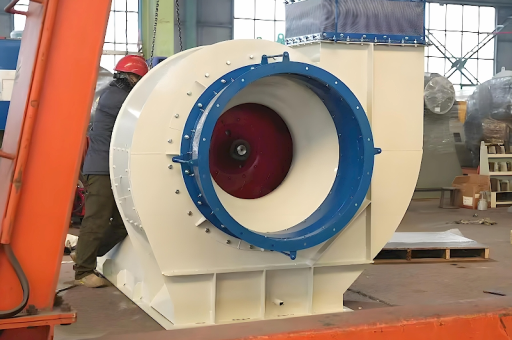
This is a highly specific and critical piece of industrial equipment. Let's break down exactly what an Industrial Power Plant Backward Double Inlet Centrifugal Fan is, where it's used, and why it's designed that way.
In short: This is a large, heavy-duty fan designed to move massive volumes of air or gas at moderate to high pressures, primarily for combustion air or flue gas handling in a power plant.
Core Terminology Explained
- Industrial Power Plant Fan: Not a small HVAC fan. These are engineered for continuous, 24/7 operation in harsh environments (high temperatures, dust, corrosive gases). Reliability is paramount.
- Backward (Curved) Inclined / Airfoil Blades: This refers to the shape and angle of the fan's impeller blades. The blades curve away from the direction of rotation.
- Double Inlet (or Double Width, Double Inlet - DWDI): The fan has an impeller that is essentially two single-inlet impellers placed back-to-back on a single shaft. Air enters the fan housing from both sides.
- Centrifugal Fan: The mechanism of air movement. Air is drawn into the center of the impeller (the eye) and is flung outwards to the periphery by centrifugal force, generating pressure.
Key Characteristics & Why They Use a Backward Design
Why Backward Curved? This is the most common and efficient blade design for large industrial applications.
- High Efficiency: Backward curved blades have less turbulence and lower air resistance. For a power plant running 8,000+ hours a year, a 1-2% efficiency gain translates to massive energy savings.
- Non-Overloading Power Curve: This is critical. The power required by a backward curved fan peaks at a certain flow rate and then drops as flow continues to increase. This means the motor will not burn out if the system's ductwork becomes less restrictive (e.g., a filter is removed or a damper fails open). A forward curved fan would overload and stall the motor in the same scenario.
- Stable Operation: They have a steep pressure curve, meaning small changes in system pressure cause larger changes in flow. This makes them very stable and predictable, which is essential for process control.
- High Speed Capability: They are well-suited for direct connection to high-speed motors (often 2-pole, 3600 RPM motors in 60 Hz regions), which allows for a more compact and cost-effective design without a gearbox.
The "Double Inlet" (DWDI) Advantage
Why two inlets instead of one?
- Higher Airflow, Same Footprint: For a given fan width, a double inlet design can handle approximately double the airflow of a single inlet fan. This is the primary reason for its use in large power plants that need enormous volumetric flow rates.
- Better Shaft & Bearing Dynamics: Air enters from both sides, creating symmetrical forces on the impeller and shaft. This cancels out the axial thrust (a force pushing the shaft sideways) that is present in a single-inlet fan. This leads to longer bearing life, less shaft fatigue, and lower vibration.
- Space & Ductwork Efficiency: You can connect large ducts to both sides, often allowing for more symmetrical and space-efficient ductwork layouts compared to a single large inlet.
Critical Applications in a Power Plant
You will find these fans in several key roles:
- Forced Draft (FD) Fan: Pushes fresh, ambient air into the boiler furnace for combustion. This is the most common application. Needs high volume and moderate pressure.
- Primary Air (PA) Fan: Sends a heated, high-pressure stream of air to the coal pulverizers (mills). This air dries the coal and carries the fine coal dust into the boiler burners. Needs high pressure.
- Induced Draft (ID) Fan: A very demanding application. Sucks the hot, corrosive, and ash-laden flue gas out of the boiler and pulls it through the pollution control equipment (ESP, scrubbers) and out the stack. These fans must be robust, often with wear-resistant linings and high-temperature shaft seals. The backward curved blade design is essential here to handle the heavy, dirty gas.
- Gas Recirculation (GR) Fan: Recirculates a portion of the flue gas back into the furnace to control boiler temperature and reduce NOx emissions.
Typical Construction & Design Features
| Feature | Description for a Power Plant Fan |
|---|---|
| Housing | Heavy-gauge steel plate, often with wear plates in the "cutoff" area (where air exits). Very large and robust to handle pressure. |
| Impeller | Large diameter (up to 4-5 meters / 13-16 feet). Blades can be airfoil (hollow, welded metal stampings) for highest efficiency, or single-thickness curved for heavy-duty/abrasive service. The hub is a massive steel forging or fabrication. |
| Shaft | Large diameter, forged alloy steel. Runs on heavy-duty bearings (typically spherical roller bearings). |
| Bearings | Supported on pedestals or bearing housings integral to the fan frame. Often require forced oil lubrication or oil ring lubrication. |
| Variable Control | To change airflow, power plants use one of two methods on these large fans: - Inlet Guide Vanes (IGVs): A set of adjustable louvers at the fan inlet. Very common and reasonably efficient. - Variable Speed Drive (VFD): Newer, far more efficient method. Uses an electronic drive to vary the motor speed (and thus fan flow). This is the gold standard for energy efficiency. |
| Coupling | Flexible coupling to connect the fan shaft to the motor shaft, accommodating minor misalignment. |
| Motor | Large, high-voltage induction motor (2.3kV, 4kV, 6.6kV, 13.8kV). Motor power can range from several hundred kW up to 5-10 MW for the largest ID fans. |
Summary for Operations & Maintenance
If you work with these fans, you know:
- Vibration is the enemy. Unbalance from erosion or ash buildup is the #1 failure cause. Permanent vibration monitoring is standard.
- Bearing health is critical. Oil analysis and temperature monitoring are essential.
- Erosion is a fact of life (especially for ID fans). Regular inspection of blade leading edges and housing wear plates is a must. The tip speed of these blades is incredibly high (100+ m/s or 330+ ft/s), and the dust acts like sandpaper.
- Performance monitoring is key. A drop in pressure rise or a rise in current draw often signals fouling, erosion, or a failing control system.
- Safety first. These are massive rotating machines with high energy. Strict lockout/tagout (LOTO) procedures are non-negotiable for any maintenance.
In conclusion, the Industrial Power Plant Backward Double Inlet Centrifugal Fan is a workhorse. It combines high efficiency, inherent safety (non-overloading power curve), and robust double-inlet construction to handle the immense air and gas volumes required for safe and efficient power generation. It is a marvel of mechanical engineering, designed to run for decades with proper care.





