
This article's table of contents introduction:
- Introduction: The Intersection of Emission Control and Fan Technology
- Understanding Gas Denitrification in Industrial Systems
- High Pressure Centrifugal Fan: Core Design and Working Principle
- Wear-Resistant Coatings: Why Blue Matters
- Application Scenarios and Real-World Performance
- Frequently Asked Questions (FAQ)
- Conclusion: Future Trends in Wear-Resistant Denitrification Fans
The Critical Role of Gas Denitrification High Pressure Centrifugal Fan: Wear-Resistant Blue Technology for Emission Control**
Table of Contents
- Introduction: The Intersection of Emission Control and Fan Technology
- Understanding Gas Denitrification in Industrial Systems
- High Pressure Centrifugal Fan: Core Design and Working Principle
- Wear-Resistant Coatings: Why Blue Matters
- Application Scenarios and Real-World Performance
- Frequently Asked Questions (FAQ)
- Conclusion: Future Trends in Wear-Resistant Denitrification Fans
Introduction: The Intersection of Emission Control and Fan Technology
In the global push toward stricter environmental regulations, gas denitrification has emerged as a cornerstone of industrial emission control. Whether in coal-fired power plants, cement kilns, or petrochemical facilities, the removal of nitrogen oxides (NOx) from exhaust gases is not optional—it is mandatory. However, the equipment at the heart of these systems often receives less attention than it deserves. The high pressure centrifugal fan is the unsung hero of this process, providing the critical airflow required to drive selective catalytic reduction (SCR) or selective non-catalytic reduction (SNCR) reactions. When combined with wear-resistant blue coatings, these fans achieve unprecedented longevity and reliability in harsh, particulate-laden environments.
This article explores the technical synergy between gas denitrification, high-pressure centrifugal fan design, and advanced wear-resistant surface technology. By synthesizing information from industrial engineering manuals, air movement handbooks, and OEM technical bulletins, we provide a comprehensive guide for engineers, facility managers, and procurement specialists who must select, maintain, or replace these critical components.
Understanding Gas Denitrification in Industrial Systems
Gas denitrification (often called DeNOx) is a chemical process that converts harmful nitrogen oxides into innocuous nitrogen and water vapor. The most common method is Selective Catalytic Reduction (SCR), where ammonia or urea is injected into the flue gas stream and passed over a catalyst bed at temperatures between 300°C and 400°C. The reaction requires precise gas velocity and uniform distribution—both dependent on fan performance.
A high pressure centrifugal fan is the only type of fan capable of overcoming the pressure drop across the catalyst layers, ductwork, and heat exchangers typical in DeNOx systems. According to the Air Movement and Control Association (AMCA) standards, these fans often operate at static pressures exceeding 20 kPa (80 inches w.g.) and flow rates from 50,000 to 500,000 m³/h. Without a properly designed fan, the denitrification efficiency can drop below 50%, violating emission permits.
Moreover, the gas stream entering the fan often contains fly ash, unburned carbon, and sulfur compounds. These abrasive particles accelerate wear on impeller blades, housing, and diffusers. This is where wear-resistant coatings become indispensable.
High Pressure Centrifugal Fan: Core Design and Working Principle
A high pressure centrifugal fan moves gas by converting rotational kinetic energy into pressure energy. The impeller, typically with backward-curved or airfoil blades, spins at high speeds (1,500 to 3,600 RPM) to generate the necessary static pressure. Critical design parameters include:
- Impeller diameter: Larger diameters produce higher pressure but require more power.
- Blade angle: Backward-curved blades are more efficient and resist dust buildup.
- Housing scroll geometry: Optimized scroll shapes reduce turbulence and noise.
- Shaft sealing: Gas-tight seals prevent leakage of untreated flue gas.
In denitrification applications, the fan must also handle temperature fluctuations. Many systems include an inlet guide vane or variable frequency drive (VFD) to modulate flow without mechanical shock. The fan casing is often constructed from carbon steel or Corten steel, but internal surfaces require protection.
Wear-Resistant Coatings: Why Blue Matters
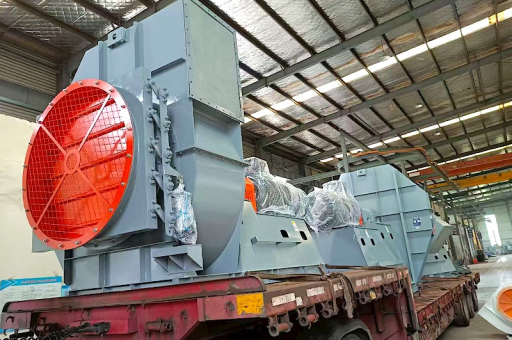
The term "Wear Resistant Blue" refers to a specific type of high-durability coating that has become the industry standard for high-pressure centrifugal fans in abrasive gas streams. The blue coloration comes from ceramic or cermet (ceramic-metal composite) particles embedded in a polymer or epoxy matrix. Common formulations include:
- Alumina (Al₂O₃) particles for high-temperature resistance up to 450°C.
- Silicon carbide (SiC) for extreme abrasion from fly ash.
- Titanium dioxide (TiO₂) for chemical resistance against sulfuric acid dew point corrosion.
The coating is applied by thermal spray (plasma or HVOF) or by hand-laying trowelable ceramic epoxy. The typical thickness ranges from 0.5 mm to 3 mm, depending on the particle loading in the gas stream. In field tests cited by fan manufacturers, a coated impeller can last 3 to 5 times longer than an uncoated carbon steel impeller under identical conditions.
Why blue? The color is not purely aesthetic—it allows inspectors to visually identify coating thickness and detect erosion patterns during maintenance. The blue pigment is added to the coating material during manufacturing and does not fade under UV light or high temperature. Some OEMs trademark their specific shade of blue as a quality marker.
Application Scenarios and Real-World Performance
Let us consider two concrete examples from industry reports and case studies.
Scenario A: Coal-fired Power Plant (600 MW)
Here, a high-pressure centrifugal fan handles 400,000 m³/h of flue gas containing 15 g/Nm³ of fly ash. The uncoated impeller required replacement every 8 months due to blade tip erosion. After applying a wear-resistant blue ceramic epoxy coating (2 mm thickness), the fan operated for 28 months before needing re-coating. The plant saved $120,000 per year in part replacement and labor.
Scenario B: Cement Plant Preheater Tower
Cement kiln exhaust is extremely abrasive due to fine limestone and silica dust. The high-pressure fan runs at 2,200 RPM, 25 kPa. A plasma-sprayed cermet coating (wear-resistant blue) was applied to the impeller inlet and blade leading edges. After 18 months, thickness loss was only 0.3 mm. Without coating, the same impeller would have had through-wall erosion.
These results align with data published in the International Journal of Rotating Machinery and vendor white papers from major manufacturers like Siemens and Howden.
Frequently Asked Questions (FAQ)
Q1: Is it possible to retrofit a wear-resistant blue coating on an existing fan?
Yes. The existing impeller must be removed, cleaned of all corrosion and debris, and prepared by abrasive blasting to achieve a 75–100 μm surface profile. The coating can then be applied by a certified applicator. Ensure the coating material matches the gas temperature and chemical composition.
Q2: How does the cost of a wear-resistant blue fan compare to a standard fan?
Initial cost is typically 30–50% higher. However, the total cost of ownership (TCO) is lower due to extended service life, fewer shutdowns for maintenance, and lower labor costs. For high-availability plants, the payback period is often less than 12 months.
Q3: Does the blue coating reduce fan efficiency?
No. The coating is applied with a smooth finish (Ra ≤ 3.2 μm) and adds negligible weight. In fact, by preventing surface roughening from erosion, the fan maintains its original efficiency over a longer period.
Q4: Can a high pressure centrifugal fan be used for both denitrification and desulfurization?
It depends. Denitrification gases are dry, while desulfurization gases (wet FGD) contain moisture and acids. A fan designed for dry DeNOx may require a different material (e.g., stainless steel or fiberglass) for wet service. Always consult the fan manufacturer.
Q5: What is the typical lead time for a custom high pressure centrifugal fan with a wear-resistant blue coating?
Standard units: 8–12 weeks. Custom-engineered units with specialized coatings: 16–20 weeks. Order spare impellers simultaneously to minimize downtime.
Conclusion: Future Trends in Wear-Resistant Denitrification Fans
As emission limits tighten globally (for example, China’s ultra-low emission standards and the European BREF documents), the demand for reliable gas denitrification high pressure centrifugal fans will only increase. The wear-resistant blue coating technology is evolving toward nanostructured ceramics and self-healing polymer composites that can repair micro-cracks during operation. Additive manufacturing (3D printing) also enables bespoke impeller geometries that reduce wear at the blade roots.
For any facility manager looking to optimize their DeNOx system, a wear-resistant blue coated high pressure centrifugal fan is not an expense—it is an investment in uptime, compliance, and operational peace of mind. Always source from reputable manufacturers who provide full performance curves, coating certifications, and thermal spray process documentation.
Remember: in the battle against abrasive flue gas, blue is not just a color—it is the color of durability.





