
This article's table of contents introduction:
- What is a Double Inlet Centrifugal Blower?
- Common Applications
- Typical Construction & Features (Heavy Duty)
- Key Performance Specifications You Need
- Example Selection Table (General Reference)
- Important Considerations
- What is your specific goal?
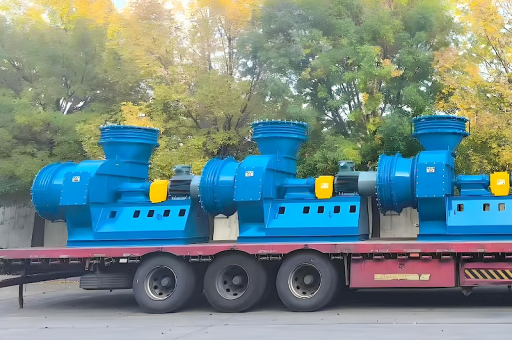
It sounds like you are looking for information or specifications on a Heavy Duty Centrifugal Fan, specifically a Double Inlet Centrifugal Blower that runs on 3-Phase power.
These are commonly known as Double Inlet, Double Width (DIDW) fans. They are industrial workhorses designed for high-volume airflow against moderate to high static pressure.
Here is a breakdown of what this typically means, common applications, and selection criteria.
What is a Double Inlet Centrifugal Blower?
- Double Inlet (DI): Air enters the fan wheel from both sides of the housing. This allows the fan to move significantly more air (CFM) than a single-inlet fan of the same wheel diameter.
- Double Width (DW): The impeller (wheel) is wider than a standard single-width fan. This further increases airflow capacity.
- 3 Phase: The motor requires a 3-phase AC power supply (e.g., 208V, 230V, 460V, 575V). This is standard for heavy-duty industrial machinery because it provides higher torque, better efficiency, and longer motor life than single-phase power.
Common Applications
These fans are used where large volumes of air must be moved reliably, often 24/7.
- HVAC Systems: Large commercial rooftop units, central station air handlers (blow-through or draw-through).
- Industrial Ventilation: Factories, warehouses, paint booths, and fume exhaust systems.
- Dust Collection: For handling dusty air (often with an abrasion-resistant coating).
- Drying Systems: Textile drying, paper mills, and agricultural dryers.
- Clean Rooms: Providing constant, high-volume filtered air.
Typical Construction & Features (Heavy Duty)
- Housing: Heavy gauge steel or fiberglass-reinforced plastic (FRP) for corrosive environments. Often designed for a Class I, II, or III construction (higher numbers = thicker metal for higher pressures).
- Impeller: Typically backward-inclined or airfoil blades (for high efficiency) or radial blades (for handling dirty/sticky material).
- Motor: TEFC (Totally Enclosed Fan Cooled) or ODP (Open Drip Proof). Mounted on a rigid base with an adjustable belt drive (most common) or direct drive.
- Bearings: Heavy-duty ball or roller bearings, often with grease lines for remote maintenance.
- Shaft: Large diameter, ground and polished, keyed to the impeller.
Key Performance Specifications You Need
To select or operate this fan, you must know or provide these three core values:
- Airflow (CFM - Cubic Feet per Minute): How much air you need to move.
- Static Pressure (SP - Inches of Water Gauge [in. w.g.]): The resistance the fan must overcome (from ducts, filters, dampers, etc.).
- Air Density (Temperature & Altitude): Standard air is 70°F at sea level. Higher temperatures or altitudes require a motor with higher horsepower.
Example Selection Table (General Reference)
Note: These are approximate values. Actual performance varies by manufacturer. You must use the manufacturer's fan curve.
| Wheel Diameter | Motor HP (3-Phase) | Approx. CFM @ 2" SP | Approx. CFM @ 4" SP |
|---|---|---|---|
| 18" | 5 HP | 6,000 | 4,500 |
| 24" | 10 HP | 12,000 | 9,000 |
| 30" | 20 HP | 20,000 | 15,000 |
| 36" | 40 HP | 35,000 | 25,000 |
Important Considerations
- Drive Type: Belt-drive is most common for heavy-duty DIDW fans. It allows you to change the fan speed (RPM) to adjust CFM by changing the pulley. Direct-drive is simpler but requires a Variable Frequency Drive (VFD) to change speed.
- Material of Construction: Standard is Carbon Steel. Stainless Steel (304/316) is needed for corrosive or hygienic applications. Aluminum is used for spark-resistant applications.
- Inlet/Outlet Configuration: Fan arrangement (e.g., Arrangement 3, Arrangement 1) determines how the motor is mounted. Rotation (CW or CCW) and discharge position (e.g., Horizontal, Downblast, Upblast) must match your ductwork.
- Wiring: A 3-phase motor requires 3 power wires (plus ground). It will not run on standard 120V/240V household power unless you use a phase converter.
What is your specific goal?
To give you a more accurate answer, please clarify:
- Are you buying one? Provide the required CFM and Static Pressure.
- Are you troubleshooting one? Describe the problem (e.g., won't start, low airflow, excessive vibration, overheating motor).
- Are you wiring one? Confirm the voltage (e.g., 230V, 460V) and the motor nameplate Full Load Amps (FLA).
- Are you looking for a part? Look for the manufacturer name and model number on the housing nameplate.
If you are in the market for one, search for: "DIDW centrifugal fan [desired CFM] [desired SP] 3 phase" using a reputable manufacturer like New York Blower, Chicago Blower, Greenheck, Twin City Fan, or Aerovent.





