
This article's table of contents introduction:
- Component Breakdown
- Key Design & Construction Features for "High Wear Resistance"
- Common Boiler Exhaust Fan Types (Centrifugal)
- Material Grades & Limitations of Carbon Steel (CS)
- Critical Application Factors for a Boiler Exhaust Fan
- Summary of Your Specification
This sounds like a specification for a heavy-duty industrial fan used in harsh environments. Here is a detailed breakdown of what this description means, the typical applications, and key considerations for procurement or design:
Component Breakdown
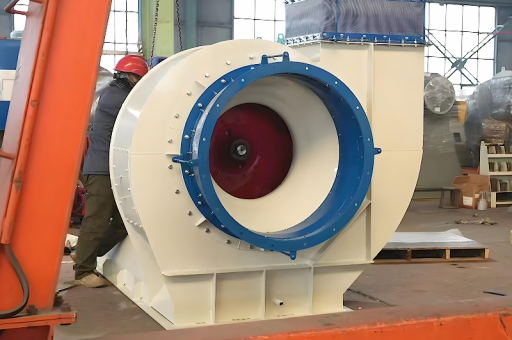
- Industrial Centrifugal Fan: The fan type. Air enters axially (along the shaft) and is discharged radially (perpendicular to the shaft). This design generates high pressure, making it ideal for moving air through ducts, against system resistance, or for material handling.
- Boiler Exhaust Fan: The specific application. This means the fan moves hot, potentially corrosive, and particle-laden flue gas from a boiler, furnace, or incinerator to the stack or emission control system.
- High Wear Resistance: A critical feature. The fan is engineered to withstand erosion caused by dust, ash, or fuel particles suspended in the gas stream.
- Carbon Steel: The primary construction material. Carbon steel offers a good balance of strength, cost, and weldability. However, for high temperatures or high corrosion, it is often lined or coated.
Key Design & Construction Features for "High Wear Resistance"
To achieve the "high wear resistance" claim, the fan must incorporate one or more of the following design elements:
| Feature | Purpose | Typical Application |
|---|---|---|
| Thickened Blade & Housing | Sacrificial thickness to extend life before material loss compromises structural integrity. | Standard for abrasive dust. |
| Hardfacing / Laminates | Applying a layer of hard, wear-resistant material (e.g., chromium carbide, tungsten carbide) to the leading edge of blades and in the scroll housing. | High-velocity fly ash or sand. |
| Recessed Blade Mounting | Welding blades so the weld seam is on the backside (non-impingement side), preventing direct erosion of the weld. | General heavy-duty. |
| Wear Liners | Replaceable plates (e.g., AR400/AR500, ceramic tiles) bolted or welded inside the housing and on the impeller. | Easiest to maintain; extends fan life significantly. |
| Wear Shrouds | Built-up material around the air inlet (inlet cone) and at the blade-to-shroud junction. | Protecting the most vulnerable areas. |
Common Boiler Exhaust Fan Types (Centrifugal)
Based on your description, the fan is likely one of these three designs, depending on the dust load:
- Radial (Paddle Wheel) Blade:
- Best for High Wear. Simple, rugged, flat blades.
- Pros: Self-cleaning, highest resistance to abrasion, handles sticky materials well.
- Cons: Lower efficiency than airfoil blades.
- Backward Inclined (BI) / Backward Curved (BC):
- Better Efficiency. Available in heavy-duty versions with thick blades.
- Pros: Higher efficiency, non-overloading power curve.
- Cons: Blades can accumulate dust if sticky; wear resistance is lower than radial unless severely reinforced.
- Airfoil Blade:
- Highest Efficiency. Hollow, aerodynamic blade shape.
- Cons: Not suitable for high wear. Dust erosion will quickly puncture the hollow blade, causing imbalance and catastrophic failure.
Conclusion for a "High Wear" boiler fan: You almost certainly want a Radial or a heavy-duty Backward Inclined fan.
Material Grades & Limitations of Carbon Steel (CS)
Standard carbon steel (e.g., A36, Q235A/B) is fine for temperatures up to about 400°C (750°F) . Above this, the steel loses strength (yield strength drops significantly).
- For higher temperatures: You need Alloy Steel (e.g., Corten, 16Mo3, 1.25Cr-0.5Mo) or Stainless Steel (e.g., 310S, 321) to prevent creep and scaling.
- Corrosion: Flue gas often contains sulfur (from coal/oil), forming sulfuric acid. Carbon steel will corrode rapidly at "acid dew point" temperatures (typically below 150°C / 300°F). In this case, you would need:
- Corten steel (better corrosion resistance but not perfect)
- Stainless steel (e.g., 316L, 904L)
- Rubber/Epoxy lining
- Wear: Carbon steel by itself is not "high wear resistant." A standard CS fan will fail quickly in an abrasive environment. The CS is merely the structural substrate upon which the wear protection (hardfacing, liners, ceramic) is applied.
Critical Application Factors for a Boiler Exhaust Fan
When specifying this fan, you must know:
- Temperature: Continuous max temp and peak/maximum allowable temperature (for startup, soot blowing, or bypass).
- Gas Composition: %O2, %CO2, presence of SOx/NOx, moisture.
- Dust Loading: Grain loading (gr/dscf) or mg/Nm³.
- Particle Analysis: Size distribution (d50, d90), composition (SiO2 = very abrasive; CaO = sticky), shape (angular = worse).
- Required Pressure: Static pressure (in H₂O or kPa) needed to overcome boiler, duct, and pollution control equipment (ESP/baghouse) resistance.
- Required Flow: Volume in CFM or m³/hr (actual, not standard).
- Motor Power: kW or HP requirement.
Summary of Your Specification
| Parameter | Description |
|---|---|
| Fan Type | Centrifugal (likely Radial or Heavy-Duty Backward Inclined) |
| Application | Boiler Exhaust (Flue Gas) |
| Wear Resistance | High (via hardfacing, liners, thick section, or ceramic tiles) |
| Construction | Carbon Steel (Base) |
| Suitable For | Hot, dusty exhaust gases (non-corrosive or mildly corrosive & high-temp) |
| Not Suitable For | Highly corrosive acid dew point conditions (needs alloy); extreme high-temp >400°C (needs alloy); very sticky materials (needs special coating or radial blade). |
Final Recommendation: Ensure you request a "Heavy Duty/Industrial Carbon Steel Paddle Wheel or Backward Inclined Fan with AR400 wear liners in the housing and chrome carbide hardfacing on the blade leading edges." This phrase will get you the correct product from a reputable fan manufacturer (like New York Blower, Howden, TLT, Cincinnati Fan, or a quality Chinese manufacturer like Yilong or Zhuhai Gongli).





