
This article's table of contents introduction:
- Core Principle & Operation
- Key Specifications (Why 380V & High Speed)
- Types of Centrifugal Fans for Dust
- Critical Factors for Selection
- Example Applications
- Safety & Compliance
- Maintenance Tips
- Buying Considerations (China & Global Sourcing)
Here is a comprehensive overview of High Speed 380V Industrial Centrifugal Fans for Dust Removal.
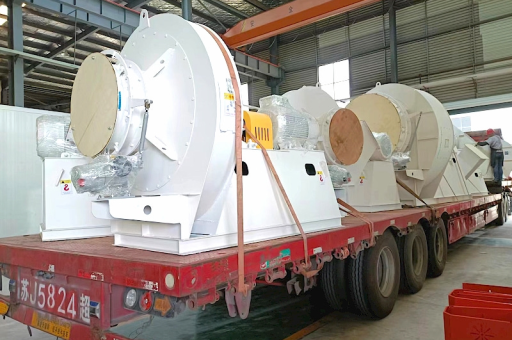
These are heavy-duty, specialized machines designed to create the high negative pressure (vacuum) and airflow velocity needed to capture and transport dust, chips, and particulate matter in industrial environments.
Core Principle & Operation
Unlike axial fans (like a desk fan), centrifugal fans increase air pressure significantly by:
- Drawing air in along the axis of the fan.
- Spinning it at high speed using a motor-driven impeller.
- Throwing it out radially (at 90 degrees) into the housing.
- Forcing it through a discharge outlet.
This design generates the high static pressure essential for:
- Overcoming resistance in long ductwork.
- Lifting heavy dust vertically.
- Creating strong suction at hoods, grinders, and saws.
Key Specifications (Why 380V & High Speed)
- 380V (3-Phase Power): This is the standard industrial voltage in many parts of the world (Europe, Asia, Africa, etc.). It provides the high torque and energy efficiency required to run a large motor continuously.
- High Speed: These fans typically run at 2900-3600 RPM (direct drive) or via belt drive. High speed is critical to generate sufficient centrifugal force to separate dust from the airstream and maintain velocity in ductwork.
Types of Centrifugal Fans for Dust
A. Material Handling / Radial Blade Fans (Most Common)
- Design: Simple, flat or slightly curved radial blades. Impeller looks like a paddle wheel.
- Pros: Most durable. Handles sticky, abrasive, heavy, or high-concentration dust. Self-cleaning design resists material build-up.
- Cons: Lower efficiency than other types. Noisier.
- Use: Wood chips, metal shavings, grain, cement, mining, heavy industrial dust.
B. Backward Inclined (BI) Fans
- Design: Blades curve away from the direction of rotation.
- Pros: Higher efficiency (lower energy costs). Quieter operation. Non-overloading power curve (motor won't burn out if duct is clear).
- Cons: Less tolerant of sticky or abrasive dust. Impeller is more likely to clog.
- Use: Cleaner industrial air, dust collectors with pre-filters, HVAC, light particulate.
C. Forward Curved (FC) Fans ("Squirrel Cage")
- Design: Blades curve into the direction of rotation.
- Pros: Very high airflow at low pressure. Compact size.
- Cons: Lowest efficiency. Cannot handle high dust loads or abrasive material. Motor can overload if static pressure drops.
- Use: Low-pressure dust collection (like small woodshops with short ducts), HVAC, clean air.
For heavy industrial dust removal, Radial Blade is almost always the best choice.
Critical Factors for Selection
| Factor | Why It Matters |
|---|---|
| Static Pressure (SP) | Must overcome duct friction + filter resistance. Measured in "mmH₂O", "Pa", or "in w.g." (water gauge). This is the most important spec. |
| Airflow (CFM / m³/h) | Must be high enough to capture dust at the source and maintain transport velocity in the duct (e.g., 4000 FPM for wood dust). |
| Impeller Material | Steel (abrasive dust), Stainless Steel (corrosive/explosive dust like metal powders or chemicals), Aluminum (spark resistance). |
| Drive Type | Direct Drive: Less maintenance, fixed speed. Belt Drive: Adjustable speed (change pulley), absorbs shock, allows motor placement away from airflow. |
| Housing Construction | Look for AR Steel (Abrasion Resistant). Thicker gauge. Some have replaceable wear plates. |
Example Applications
- Woodworking: CNC machines, planers, sanders, saws.
- Metalworking: Grinding, welding fume extraction, shot blasting.
- Agriculture: Grain elevators, feed mills, silo ventilation.
- Mining & Cement: Dust collection at conveyors, crushers, silos.
- Pharmaceutical/Food: Safety containment of fine powders (e.g., sugar, flour, active ingredients).
Safety & Compliance
- ATEX / IECEx (Explosion Proof): Fan and motor must be rated for dust explosion zones (e.g., Zone 21/22 for combustible dust like wood, grain, metal, coal).
- Earthing: Proper grounding to prevent static spark.
- Spark Arresting: Non-sparking impeller (aluminum or copper-tipped steel), housing lining, or spark trap in duct.
- Shielding: Shaft seals to prevent dust escaping into bearings/motor.
Maintenance Tips
- Balance Impeller: Dust build-up can unbalance the impeller, causing severe vibration and bearing failure. Clean regularly.
- Check Bearings: High speed generates heat. Use high-temp grease. Monitor for vibration or noise.
- Inspect Wear Plates: Replace before the housing itself is worn through.
- Belt Tension: For belt-driven units, loose belts cause slippage and loss of speed/CEM. Tight belts cause bearing wear.
- Clean Ducts: Inspect for blockages that increase static pressure and reduce airflow.
Buying Considerations (China & Global Sourcing)
If sourcing from manufacturers (common in China, India, Germany, Italy, USA):
- Key Manufacturers (Known for this application):
- New York Blower (USA)
- Cincinnati Fan (USA)
- Systemair (Europe)
- AXFAN (UK)
- Ventilair (Italy)
- Zibo Boshen / Shenzhen Kai Feng (China)
- What to ask for in a quote:
- "Radial blade, material handling design"
- "Maximum gas temperature" (e.g., 80°C or 200°C)
- "Speed: 2900 rpm or belt driven for adjustment"
- "Material: Q235 steel or 304 Stainless"
- "Include vibration isolators and inlet screen"
- "Certification: CE, ATEX (if needed), ISO 9001"
Summary: For "High Speed 380V Industrial Centrifugal Fans For Dust Removal", you are looking for a heavy-duty, radial blade (paddle wheel) fan with a 380V 3-phase motor, designed for high static pressure and abrasive material handling. Sizing must be done by an engineer based on your specific ductwork length, dust type, and machine demand.





