
This article's table of contents introduction:
- What is a 110 kW Centrifugal Fan?
- Key Characteristics of a 110 kW Fan
- Typical Applications (Where you find them)
- Critical Considerations for Selection & Operation
- Example: Boiler ID Fan Data Sheet (Typical for 110kW)
- Summary for a 110 kW Fan
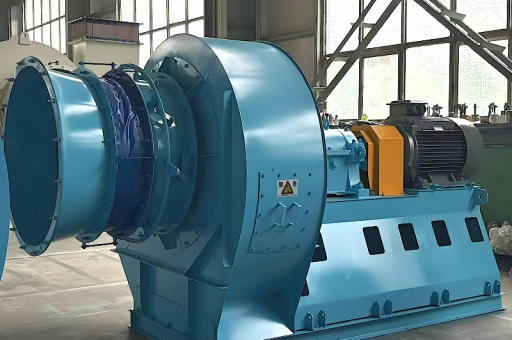
This is a specific and powerful piece of industrial equipment. A 110 kW (approximately 150 HP) centrifugal fan is a significant machine, typically found in heavy industrial applications.
Here is a comprehensive breakdown of what this machine is, its applications, its key characteristics, and important considerations.
What is a 110 kW Centrifugal Fan?
It's a fan that uses a rotating impeller to increase the velocity and pressure of air or gas. The "110 kW" rating refers to the motor power required to drive the fan under its design conditions. This is not a fixed output of the fan, but the power consumption at its operating point.
Key Characteristics of a 110 kW Fan
- High Airflow & Pressure: This power level allows for moving very large volumes of air (e.g., 50,000 to 150,000 m³/h or more) against a significant system resistance (pressure), often 2,000 to 8,000 Pa.
- Large Physical Size: The fan housing, impeller, and inlet/outlet ducts are large. The impeller diameter could be 1.2 to 2.5 meters (4 to 8 feet).
- Heavy Construction: Built from robust materials like:
- Carbon Steel: Standard for clean air.
- Stainless Steel (304/316): For corrosive or hygienic environments.
- Abrasion-Resistant Steel (AR400/500): For dusty or particulate-laden air (cement, mining).
- High Starting Current: A 110 kW motor, when started direct-online (DOL), can draw 6-8 times its full-load current (around 700-800 Amps), causing major electrical stress.
- Specialized Bearings and Shaft: Heavy-duty roller or sleeve bearings are required to handle the loads.
- Vibration Sensitivity: Requires a robust foundation and careful balancing to avoid destructive vibration.
Typical Applications (Where you find them)
These fans are workhorses in large-scale processes:
- Cement Plants:
- Kiln ID (Induced Draft) fans.
- Raw mill and finish mill ventilation.
- Clinker cooler fans.
- Power Generation:
- Boiler FD (Forced Draft) and ID (Induced Draft) fans.
- Primary air fans for coal mills.
- FGD (Flue Gas Desulfurization) system fans.
- Mining & Minerals Processing:
- Main mine ventilation fans.
- Dust collection for crushers and conveyors.
- Steel Mills:
- Converter and electric arc furnace ventilation.
- Sinter plant exhaust fans.
- HVAC & Tunnel Ventilation:
- Central station air handling units for large buildings (airports, convention centers).
- Road and railway tunnel ventilation fans.
- Chemical & Petrochemical:
- Process gas handling.
- Cooling tower fans (though often axial).
Critical Considerations for Selection & Operation
-
The Fan Curve is King: The fan's performance is defined by its curve (Pressure vs. Flow). The System Curve (resistance of the ducts, filters, dampers) dictates where on the fan curve the fan actually operates.
- Mismatch: If the system resistance is higher than designed, the fan will move less air and the motor may overload (because power consumption can peak at a different point on the curve).
- Result: Can lead to damaged motor or destroyed fan.
-
Control Methods (Crucial for 110kW):
- Direct-On-Line (DOL): Simplest, but high starting current. Only for low-inertia, soft-starting applications. Rarely recommended for 110kW.
- Star-Delta Starter: Reduces starting current to ~2-3x FLC. A common and cost-effective solution.
- Soft Starter: Ramps up voltage, providing smoother acceleration and reduced mechanical stress. Highly recommended for most applications.
- Variable Frequency Drive (VFD): The Gold Standard. Allows precise control of fan speed (and thus airflow/power). Saves massive energy (50% speed = 12.5% fan power) and eliminates starting current issues. The most expensive but most efficient control method.
-
Motor Specifications:
- Voltage: Typical industrial voltages: 380V, 400V, 415V (50Hz) or 480V (60Hz). For a 110kW motor, Medium Voltage (e.g., 6.6kV or 11kV) is very common in larger plants to reduce current and cable sizes.
- Efficiency Class: Should be IE3 (Premium Efficiency) or IE4 (Super Premium Efficiency).
- Enclosure: TEFC (Totally Enclosed Fan Cooled) for clean environments, or TEAAC (Totally Enclosed Air-to-Air Cooled) for dusty locations.
-
Maintenance is Not Optional:
- Vibration Analysis: Continuous monitoring is standard. Unbalance, misalignment, or bearing failure will be detected early.
- Bearing Greasing/Oiling: High-load bearings need regular attention.
- Belt Tension: If belt-driven (less common at this power, but possible), tension must be precise.
- Impeller Inspection: Check for wear (especially on the leading edges), erosion, or buildup of material.
- Thermal Imaging: Monitor motor and bearing temperatures.
-
Safety:
- Lockout/Tagout (LOTO): Absolute necessity. The impeller can store significant rotational energy (flywheel effect) and take a long time to spin down.
- Guarding: All rotating parts, including the shaft coupling and fan inlet/outlet, must be guarded.
- Electrical Safety: High voltage and high current equipment demands trained personnel.
Example: Boiler ID Fan Data Sheet (Typical for 110kW)
| Parameter | Specification |
|---|---|
| Fan Type | Backward-Curved (Airfoil or Flat) |
| Service | Induced Draft (Boiler Exhaust) |
| Volume Flow | 80,000 m³/h |
| Static Pressure | 4,500 Pa |
| Operating Temp | 180°C (with cooling fan/materials) |
| Power (Motor) | 110 kW |
| Motor Speed | 1,480 rpm (4-pole) or 980 rpm (6-pole) |
| Control | VFD (Variable Frequency Drive) |
| Material | Carbon Steel (with ST50 impeller) |
Summary for a 110 kW Fan
| Aspect | Key Point |
|---|---|
| Power | ~150 HP. Major electrical infrastructure required. |
| Control | Use a VFD or Soft Starter. Direct-on-line is a bad idea. |
| Application | Heavy industry: cement, power, mining, steel, large HVAC. |
| Maintenance | Non-negotiable. Vibration analysis is critical for long life. |
| Cost | High upfront capital cost, but significant energy savings potential with good control. |
If you are specifying or troubleshooting a 110kW centrifugal fan, the most critical parameters are the fan curve, the system curve, and the control method (VFD preferred). Getting these right determines whether it operates efficiently or fails prematurely.





