
This article's table of contents introduction:
- What does this specification mean?
- Why HG785 Steel? (Physics)
- Typical Applications
- Critical Design Differences (Why you can't use a standard fan)
- Selection Guide (What to ask the manufacturer)
- Potential Manufacturers
- Summary
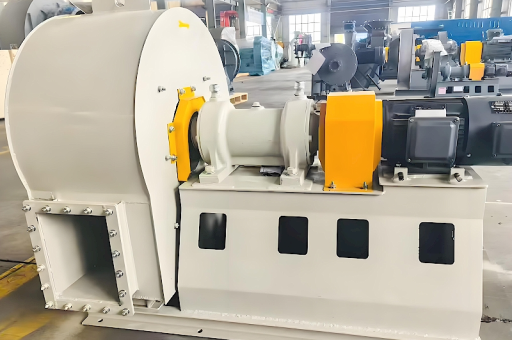
It appears you are looking for a specific industrial blower configuration that combines high-strength steel (HG785) with a backward curved/backward inclined air purification system for material handling.
Here is the breakdown of what that specification means, its applications, and the key engineering considerations.
What does this specification mean?
- HG785 Alloyed Steel: This is a high-strength low-alloy (HSLA) steel with a yield strength of approximately 785 MPa. It is significantly stronger than standard mild steel (Q235) but lighter than abrasion-resistant steel (like Hardox). It is used for the impeller and housing to withstand high rotational speeds and pressure without adding excessive weight.
- Backward (Airfoil/Curved): This refers to the blade design. Backward curved (BC) or backward inclined (BI) blades are non-overloading. This means the motor cannot burn out if the system pressure drops (e.g., a duct breaks).
- Air Purification: The blower is likely designed for dust collection, fume extraction, or clean air handling in a semi-clean environment (not heavily loaded with abrasive material).
- Material Handling: Despite being for "air purification," the HG785 steel suggests the material being moved might be abrasive dust (e.g., sanding dust, weld fume, metal shavings) or the blower operates at high pressure (pneumatic conveying).
Why HG785 Steel? (Physics)
Normal blowers use mild steel. If a standard blower were built to the same pressure/speed rating as one using HG785:
- Thickness: HG785 allows for thinner housing and impeller walls (approx. 30-50% thinner).
- Weight Reduction: Lighter impeller means lower inertia, leading to faster startup and less stress on bearings.
- Critical Speed: A thinner, lighter impeller can often run at higher RPM (tip speeds) before reaching destructive resonance speeds.
Typical Applications
- High-Pressure Pneumatic Conveying: Moving powders, pellets, or dust over long distances where a high pressure differential is required, but the material is fine enough to stay entrained (not impact the impeller).
- Dust Collection for Abrasive Materials: Handling sanding dust, fiberglass, or aluminum oxide.
- Weld Fume Extraction: High volume, moderate pressure. The HG785 allows the impeller to handle the heat and minor sparks without deforming.
- Central Vacuum Systems: Large industrial vacuum cleaners where "material handling" is the primary function.
Critical Design Differences (Why you can't use a standard fan)
If you are designing or sourcing this blower, pay attention to these factors:
- Shaft Diameter: HG785 impellers are stiffer, but the shaft must be sized for the critical speed. The impeller's lower mass helps, but the moment of inertia calculation is key.
- Abrasiveness vs. Erosion: Warning: HG785 is not abrasion resistant like AR400 or Hardox. If the "material handling" involves heavy particles (e.g., shot blasting debris) impacting the impeller at high speed, the HG785 will erode quickly. You would need liner plates or a wear shroud inside the housing.
- Spark Resistance: For weld fume or combustible dust, HG785 alone is not enough. You may need a stainless steel impeller (for non-sparking) or a copper ring in the inlet cone, combined with the HG785 housing.
- Balance Grade: Because it is a "backward" blower (high speed), the impeller must be dynamically balanced to G2.5 grade (or better) to prevent bearing failure.
Selection Guide (What to ask the manufacturer)
If you are sourcing this, do not simply ask for an "HG785 alloyed steel blower." Ask for:
- Pressure & Volume: What is the static pressure (inches w.g. or Pa) and CFM required?
- Material type: Is it abrasive? Is it explosive? What is the particle size (microns)?
- Temperature: Is the air hot (e.g., above 80°C)? HG785 loses strength above ~200°C.
- Impeller Style: True Backward Airfoil (BC) (high efficiency, high speed, low noise) vs. Backward Inclined (BI) (lower efficiency, easier to clean, handles slightly more sticky material).
- Drive Type: Direct drive (motor shaft supports impeller) or Belt drive (allows speed change but requires heavy bearing pedestal).
Potential Manufacturers
This is a specific industrial product, not a standard HVAC fan. You would typically look at:
- New York Blower (USA)
- Howden / Clarage
- Greenheck (Industrial series)
- Cincinnati Fan
- Sichuan Fangquan (Chinese manufacturer specializing in HG785 for material handling)
Summary
You are describing a high-performance, high-pressure industrial blower designed for a demanding pneumatic conveying or dust collection application where weight and high rotational speed are critical, but the material being handled is not highly abrasive.
If the material is abrasive (e.g., steel shot, sand), do not use HG785 for the impeller. You need abrasion-resistant steel (AR400) or a ceramic coating.





