
This article's table of contents introduction:
- The Application Context (The "Why")
- Critical Engineering Challenges
- Design Specifications (Heavy Duty Features)
- Typical Operating Parameters (Example)
- Critical Selection Questions
- Summary Recommendation
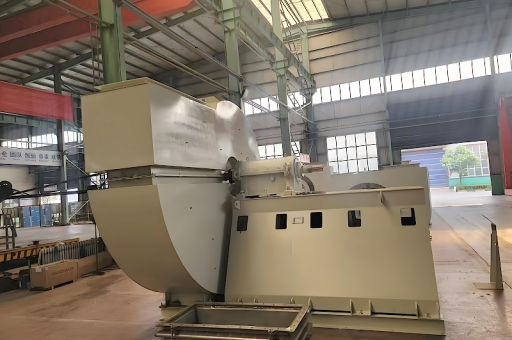
This is a very specific industrial equipment query. You are looking at a Heavy Duty Centrifugal Fan designed for a Flue Gas Desulfurization (FGD) system downstream of a Lime Rotary Kiln.
These fans operate under some of the harshest conditions in a cement or lime plant: high temperature, corrosive gas (SO₂), and abrasive dust.
Here is a detailed breakdown of what this fan is, the engineering challenges it faces, and the specific design features required.
The Application Context (The "Why")
- Source: A lime rotary kiln produces lime (CaO) by calcining limestone (CaCO₃). The fuel (coal, gas, or petcoke) and the decomposition process create flue gas containing SO₂ and particulate matter (lime dust).
- The Process (FGD): The gas is sent to a scrubber (often a wet scrubber using a lime slurry). The fan must push or pull this dirty, hot gas from the kiln through the scrubbing system.
- The Fan Role: The Heavy Duty Centrifugal Fan is usually the Induced Draft (ID) Fan located after the scrubber (downstream) or the Booster Fan if the system pressure drop is high. It maintains negative pressure in the kiln and overcomes the resistance of the scrubber, ducts, and stack.
Critical Engineering Challenges
Operating a fan in this environment is extremely difficult. The design must solve these specific problems:
- High Temperature: Gas entering the scrubber can be 200°C - 350°C (392°F - 662°F). After the scrubber, the gas is saturated with water vapor and cooled to ~50°C - 80°C (122°F - 176°F).
- Corrosion: SO₂ dissolves in water to form sulfurous acid (H₂SO₃). If the gas temperature drops below the acid dew point, concentrated sulfuric acid (H₂SO₄) forms, causing rapid corrosion of standard carbon steel.
- Abrasion: Lime dust (CaO, CaCO₃) and fly ash are highly abrasive. Even in a wet scrubber, carryover of slurry droplets can cause erosion.
- Condensation & Wet Stacks: After the wet scrubber, the gas is saturated. Liquid water droplets (mist) can cause severe vibration and blade damage (water hammer) at high speeds.
- High Static Pressure: Scrubber towers have significant pressure drops (1.5 - 3 kPa or 6 - 12 in. wg). The fan must generate high pressure reliably.
Design Specifications (Heavy Duty Features)
A standard centrifugal fan will fail quickly. You need a purpose-built HD fan. Here are the mandatory design features:
A. Impeller Design (The Heart)
- Type: Backward-Curved Airfoil or Flat Blades. Airfoil blades are more efficient for large volumes, but flat or curved plate blades are more robust for abrasive dust. Radial or Radial-Tip blades are sometimes preferred for extreme dust loads, but they are less efficient.
- Material: Wear-Resistant Steel or Stainless Steel (e.g., Corten, SAE 450, or 316L SS for specific corrosion zones). The leading edges of the blades must have weld-on hard facing (e.g., Stellite) or sacrificial wear plates.
- Profile: Thick, robust blade shanks and shrouds. The impeller must be dynamically balanced to Grade G6.3 (ISO 1940) or better to handle the vibration from moisture and dust.
B. Housing & Shaft
- Housing: Heavy gauge steel (typically 3/8" to 1/2" or 10-12 mm) with continuous welded seams. The scroll design must minimize solids buildup.
- Lining: The interior of the housing (scrolled side) must have replaceable wear liners (typically 6-12mm thick rubber, ceramic tiles, or abrasion-resistant steel). For wet FGD, a rubber lining also provides corrosion resistance.
- Shaft Seals: The shaft penetration into the fan housing is a critical leak point. Heavy-duty labyrinth seals or purged seals (using compressed air) are required to prevent gas leakage and protect the bearings from dust and acid.
C. Bearings & Lubrication
- Type: Spherical Roller Bearings in heavy-duty, sealed pillow block housings (e.g., SKF, FAG, Dodge).
- Cooling: For high-temperature applications, the bearing housing must have a water cooling jacket or be mounted on a heat sink (pedestal) to dissipate heat conducted down the shaft.
- Lubrication: Centralized grease lubrication system or oil bath with sight glasses.
D. Variable Speed Drive (VSD)
This is non-negotiable for modern FGD systems. The fan must be driven by a Variable Frequency Drive (VFD) to:
- Adjust gas flow rates as the kiln load changes.
- Control the kiln draft precisely.
- Avoid mechanical resonance during start-up.
- Reduce wear and energy consumption compared to damper control.
Typical Operating Parameters (Example)
- Volume: 100,000 to 500,000 m³/hr (60,000 to 300,000 CFM)
- Static Pressure: 3,000 to 8,000 Pa (12 to 32 in. wg)
- Temperature: 50°C to 180°C (after scrubber)
- Dust Load: Up to 50 mg/Nm³ (after ESP/baghouse) or 200 mg/Nm³ (directly from scrubber)
- Material: Saturated gas with SO₂, H₂O, CaSO₄ slurry droplets.
Critical Selection Questions
If you are sourcing this fan, you must provide or confirm:
- Location: Is this the ID fan after the scrubber (wet gas) or the booster fan before the scrubber (dry hot gas)?
- Gas Composition: Exact SO₂ concentration, temperature range, and dew point.
- Corrosion Allowance: Have you specified a material that handles the acid dew point? (e.g., 316L SS, Duplex SS, or coating).
- Accessories: Is a shaft grounding ring included (to prevent electrolytic damage from VFD harmonics)? Are drains included on the housing for condensation?
- Mounting: Is the base plate flat or do you need a concrete pedestal for the heat break?
Summary Recommendation
You are not looking for a standard industrial fan. You need a custom-engineered, heavy-duty, centrifugal fan with a reinforced impeller, abrasion-resistant lining, high-temperature bearings, and a corrosion-resistant housing. Expect the cost to be 3–5x higher than a standard air-moving fan due to the materials and engineering required.
Leading manufacturers for this specific application typically include:
- TLT-Turbo / Howden (Specialized in FGD)
- FläktGroup / Woods
- Chicago Blower
- New York Blower
- Cincinnati Fan (Heavy Duty Division)
- Ziehl-Abegg (For more standard heavy duty)
Final Advice: Work closely with the fan manufacturer's application engineer. Provide them with the certified gas analysis (both at inlet and outlet of the scrubber) to ensure the material of construction matches the real-world chemistry of your kiln's exhaust. Never assume the gas is dry or clean.





