
This article's table of contents introduction:
- What is HG785 Alloyed Steel?
- Why use HG785 for Centrifugal Fans?
- Typical Applications
- Key Challenges & Considerations
- Summary for Specification
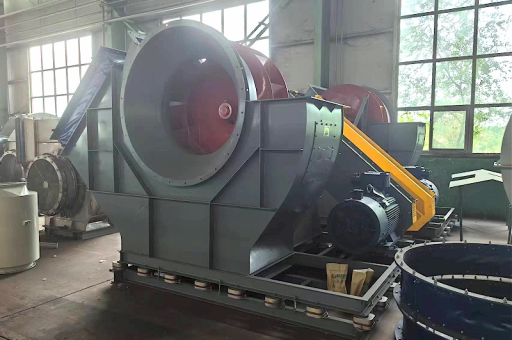
It appears you are looking for information on Industrial Centrifugal Fans manufactured from HG785 Alloyed Steel.
Here is a detailed breakdown of what that combination means, its advantages, applications, and considerations.
What is HG785 Alloyed Steel?
HG785 is a high-strength, low-alloy (HSLA) structural steel produced to Chinese standard GB/T 16270. It is roughly equivalent to international grades like S690QL (EN 10025) or A514 (ASTM).
Key Properties:
- High Yield Strength: Minimum yield strength of 690 MPa (100,000 psi).
- High Tensile Strength: Typically between 770–940 MPa.
- Good Weldability: Provided correct preheating and low-hydrogen welding processes are used.
- Excellent Toughness: Good impact resistance, even at low temperatures (often tested at -40°C).
Why use HG785 for Centrifugal Fans?
For heavy-duty industrial fans, the choice of material is critical. Using HG785 offers specific advantages over standard structural steel (Q235) or standard mild steel:
| Feature | Benefit for Centrifugal Fans |
|---|---|
| Higher Strength-to-Weight Ratio | The fan impeller (wheel) and housing can be made thinner and lighter while maintaining the same structural integrity. This reduces the moment of inertia, allowing for faster acceleration and lower bearing loads. |
| Reduced Thickness | A thinner wheel means less material is subject to centrifugal stress. This is crucial for high-speed or high-pressure fan applications. |
| Fatigue Resistance | HG785 has superior fatigue strength. This is vital for fans that run 24/7 or experience variable loads, as blade roots and weld joints are prone to cracking in standard steel. |
| Weight Reduction | A lighter fan assembly means the entire support structure (base plates, ductwork supports) can be lighter, saving on overall installation costs. |
| Higher RPM Capability | The high yield strength allows the impeller to spin at higher tip speeds without plastic deformation or bursting. This translates to higher pressure generation in a smaller package. |
Typical Applications
Fans made from HG785 are used where standard steel fans would be too heavy, too thick, or would fail under stress. Common industries include:
- Cement & Mining: For heavy dust-laden air (ID fans, raw mill fans) where erosion and high stress are common.
- Steel Mills: For high-temperature exhaust fans (sintering, blast furnace gas) where strength at elevated temperatures is needed (though for very high heat, alloys with more chromium/moly are better).
- Power Generation: For boiler draft fans (ID and FD fans), especially those requiring high static pressure.
- Tunnel Ventilation: For large jet fans or axial/centrifugal fans requiring high thrust from a compact, lightweight rotor.
- Chemical Processing: For handling gases at high pressure in corrosive environments (often with a rubber or special coating over the HG785 base).
Key Challenges & Considerations
Using HG785 is not a "drop-in" replacement for mild steel. Fabricators must follow strict procedures:
- Welding is Critical:
- Preheat: Required (typically 100-200°C depending on thickness) to prevent hydrogen-induced cracking.
- Consumables: Must use low-hydrogen electrodes or wire (e.g., ER70S-6 is often insufficient; special matching filler metals may be needed for high-stress welds).
- Post-Weld Heat Treatment (PWHT): Often required to relieve stress in thick sections.
- Fabrication Cost: The material itself is more expensive, and the welding labor and testing (e.g., NDT) are significantly higher.
- Corrosion Resistance: HG785 has similar corrosion resistance to mild steel. If the fan handles corrosive gases, it will need a protective lining (e.g., rubber, epoxy, stainless steel cladding).
- Forming: Bending the steel to form the fan scroll or impeller blades requires higher tonnage presses and special tooling to avoid spring-back or cracking.
Summary for Specification
If you are specifying a fan in this category, you are likely looking for a High-Pressure, Heavy-Duty Industrial Fan.
- Material: HG785 (or equal: S690QL, A514 Grade Q)
- Construction: Fully welded, stress-relieved.
- Testing: 100% weld inspection (MPI or Dye Penetrant) on critical welds (blade-to-backplate, blade-to-shroud). Overspeed test (typically 110% of max RPM).
- Coating: High-performance epoxy or specialized lining for the application environment.
Conclusion: An HG785 alloyed steel centrifugal fan is a premium product designed for extreme reliability and high performance in the most demanding industrial environments. It is heavier in engineering requirements but lighter in physical weight, offering a superior solution for high-stress, high-speed fan applications.
Would you like me to explain the difference between HG785 and a standard Stainless Steel fan for corrosive environments?





