
This article's table of contents introduction:
- What the Name Tells Us
- Key Design Features for EAF Service
- How it Works in the EAF System
- Common Specifications (Typical Parameters)
- Advantages of the 5-12 Series for EAF
- Potential Issues & Maintenance
- Summary
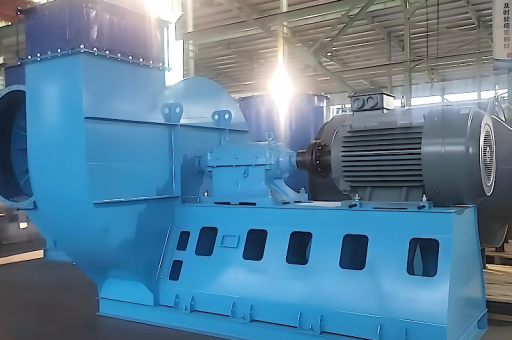
This is a specific piece of industrial equipment. Let's break down what the "5-12 Series Electric Arc Furnace Exhaust Purification Centrifugal Fan (Induced Draft Fan)" is.
This is a heavy-duty centrifugal fan designed specifically for the demanding application of Electric Arc Furnace (EAF) fume extraction and air pollution control.
Here is a detailed breakdown of its components, design features, and application.
What the Name Tells Us
- "5-12 Series" : This is the model/series designation of the fan. It tells you the specific aerodynamic design of the impeller and housing. This is likely a Chinese or European standard design series (common in industrial fan manufacturing). The numbers often relate to the specific speed and pressure coefficient of the design.
- "Electric Arc Furnace (EAF) Exhaust Purification" : This is the application. It's not a general-purpose fan. It's designed to handle the hot, dirty, and highly variable exhaust gases from an electric arc furnace used in steelmaking.
- "Centrifugal Fan" : The type of fan. It uses a rotating impeller to increase the velocity and pressure of the gas. For EAF applications, it's almost always a radial-blade or backward-inclined centrifugal design.
- "Induced Draft Fan (ID Fan)" : This is the fan's role in the system. It is placed after the pollution control equipment (like a baghouse or scrubber), pulling the gas through the system and creating a negative pressure (suction) at the furnace. This is critical for capturing fugitive emissions from the furnace roof.
Key Design Features for EAF Service
This is not a standard HVAC fan. It must be robust to survive the extreme conditions.
-
High-Temperature Construction:
- Material: The impeller and housing are typically made of high-strength, heat-resistant steel (e.g., Q345R, 16Mn, or even stainless steel for extreme cases).
- Cooling: The fan shaft is often fitted with a cooling impeller (a small fan on the shaft behind the main impeller) to cool the bearings and prevent heat transfer.
- Expansion: The housing is designed with expansion joints or a floating bearing housing to allow for thermal expansion of the shaft and casing.
-
Abrasion-Resistant Design:
- EAF gas contains heavy dust particles (iron oxide, lime, scale).
- The fan features thicker impeller blades, often with replaceable wear liners on the leading edge and inside the housing.
- The blade profile is often radial (straight) or radial-tipped to withstand erosion better than backward-curved blades.
-
Variable Operating Conditions:
- Inlet Guide Vanes (IGVs): Almost all EAF ID fans are equipped with IGVs. These are movable louvers at the fan inlet that control the gas flow. This allows the fan to match the wildly varying gas volume from the furnace (charging, melting, tapping, idle).
- Variable Frequency Drive (VFD) Compatibility: The fan motor is often controlled by a VFD for energy savings and precise control. The fan design must handle the RPM range.
-
Gas Tightness:
EAF gas is hazardous (CO, hot). The fan housing must be gas-tight. Shaft seals (often labyrinth or carbon-ring seals) prevent leakage of hot, dirty gas into the bearing housing or the atmosphere.
How it Works in the EAF System
- Furnace Hood: Fume and hot air (up to 1000°C) are captured by a canopy hood over the furnace.
- Quenching / Pre-cooling: The gas passes through a quench duct or a spark arrester to cool it down (e.g., from 1000°C to 200-300°C) to protect the baghouse and fan.
- Pollution Control Device: The gas then enters a baghouse (fabric filter) or a wet scrubber. The primary fan is often on the clean side of this device.
- Induced Draft Fan (5-12 Series Fan): This fan creates the negative pressure to draw the gas through the entire system. It handles the final, slightly cooled, but still warm (e.g., 100-150°C) and clean (or partially clean) gas.
- Exhaust Stack: The fan pushes the clean gas out through a stack.
Common Specifications (Typical Parameters)
- Flow Rate: 100,000 to over 1,000,000 m³/h (high volume).
- Static Pressure: 3,000 to 8,000 Pa (high pressure to overcome system resistance).
- Temperature: Designed for inlet temperatures from 150°C to 350°C (or higher with specialized cooling).
- Motor Power: 200 kW to 2,000+ kW.
- Speed: 600 - 1,200 RPM (low speed for durability).
Advantages of the 5-12 Series for EAF
- High Efficiency: The "5-12" aerodynamic design typically offers good efficiency (around 80-85%) for its pressure and flow characteristics.
- Robustness: The radial blade design handles heavy dust loading without becoming clogged like a backward-curved blade.
- Reliability: With proper bearings, cooling, and wear protection, these fans are designed for 24/7 continuous operation in a harsh environment.
Potential Issues & Maintenance
- Imbalance: The #1 problem. Dust build-up on the impeller (especially with wet gas) causes severe vibration. Belt cleaning of the impeller (using compressed air or a water spray while running) is a critical maintenance task.
- Bearing Failure: Due to heat and vibration. Regular temperature monitoring and greasing are required.
- Wear: On the impeller blades and housing. Frequent inspections for erosion are necessary. Replacement of wear liners is a standard maintenance activity.
- Inlet Guide Vane (IGV) Sticking: Dust and heat can cause the IGVs to seize. They need periodic lubrication and cleaning.
Summary
The 5-12 series centrifugal induced draft fan is a high-performance, heavy-duty industrial fan specifically engineered for the primary fume exhaust system of an Electric Arc Furnace.
- Purpose: To provide the necessary suction to pull hot, dusty, and toxic gas from the furnace through a pollution control system.
- Key Features: High temperature/corrosion/abrasion resistance, radial blade design, inlet guide vanes, and a robust bearing/cooling system.
- Application: It is the main workhorse for EAF emission control in steel mini-mills.
If you need to purchase or maintain one, look for:
- Manufacturers: Zibo Ruiying, Shandong Tianli, Chongqing General, or European brands like Ventilatorenfabrik Oelde.
- Spare Parts: Impeller, wear liners, shaft assembly, bearing housing, and inlet guide vane assembly.
- Key Performance Indicator: Vibration levels (ISO 14691 Grade G2.5 or better).





