
This article's table of contents introduction:
- Table of Contents
- Introduction
- Core Definition: What is a Resistant High Temperature Centrifugal Fan?
- Key Technical Challenges for Industrial Fan Manufacturers
- Application Scenarios in Power Plants
- How to Choose the Right Fan: A Buyer’s Checklist
- Frequently Asked Questions (FAQ)
- Conclusion
** The Critical Role of Resistant High Temperature Centrifugal Fans in Power Plants: A Technical Guide for Industrial Fan Manufacturers
Article:
Table of Contents
- Introduction: Why High Temperature Resistance Matters in Power Generation
- Core Definition: What is a Resistant High Temperature Centrifugal Fan?
- Key Technical Challenges for Industrial Fan Manufacturers
- Material Selection & Thermal Stress
- Bearing & Cooling System Design
- Impeller Balancing & Vibration Control
- Application Scenarios in Power Plants
- Boiler Induced Draft (ID) Fans
- Flue Gas Desulfurization (FGD) Systems
- Biomass & Coal-Fired Plant Integration
- How to Choose the Right Fan: A Buyer’s Checklist
- Frequently Asked Questions (FAQ)
- Conclusion: The Future of High Temperature Centrifugal Fan Technology
Introduction
In modern power plants, the continuous operation of thermal systems depends heavily on robust ventilation and gas handling equipment. Among these, the resistant high temperature centrifugal fan stands out as a critical component. Unlike standard fans, these units are designed to handle gas streams that can exceed 400°C (752°F) while maintaining structural integrity and aerodynamic efficiency. For power plant industrial fan manufacturers, mastering the production of such fans is not just a technical challenge—it is a competitive advantage in a market that demands reliability, energy efficiency, and compliance with emission standards.
This article provides a deep technical analysis of these fans, covering material science, cooling strategies, and application-specific design features. It also addresses common questions from procurement engineers and maintenance teams, making it a valuable resource for both buyers and manufacturers.
Core Definition: What is a Resistant High Temperature Centrifugal Fan?
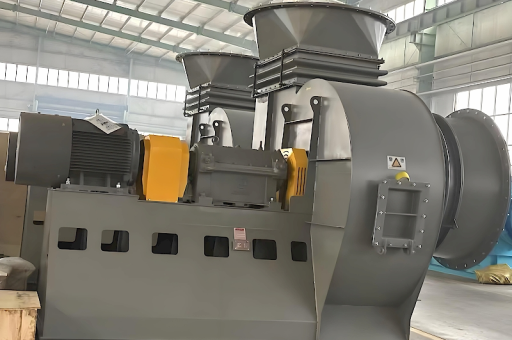
A resistant high temperature centrifugal fan is a mechanical device that moves hot gases or air by converting rotational kinetic energy into hydrodynamic energy. The term "resistant" refers to its ability to withstand thermal oxidation, creep deformation, and fatigue cracking under sustained high-temperature operation. Unlike standard fans that may use painted steel or aluminum impellers, these units are fabricated from high-alloy stainless steels (e.g., 310S, 316L) or specialized nickel-based alloys. Their design also incorporates thermal expansion gaps and advanced shaft sealing to prevent gas leakage.
For industrial fan manufacturers, the key differentiator is the ability to certify fan performance at elevated temperatures—often through finite element analysis (FEA) and physical hot-testing. A fan that fails at 350°C can cause catastrophic downtime in a power plant, making quality assurance paramount.
Key Technical Challenges for Industrial Fan Manufacturers
1 Material Selection & Thermal Stress
At high temperatures, materials lose yield strength and become susceptible to creep. For example, carbon steel loses 50% of its strength above 380°C. Therefore, manufacturers must select alloys with high oxidation resistance and thermal fatigue life. 310S stainless steel is a common choice for impellers because it maintains corrosion resistance up to 1100°C. However, its cost is 2–3 times higher than standard stainless steel. Another option is Hastelloy X, which offers exceptional high-temperature strength but is significantly more expensive.
2 Bearing & Cooling System Design
Bearings are the most vulnerable components in a high-temperature fan. When the shaft conducts heat from the impeller, bearing temperatures can rise above 120°C, leading to grease breakdown and premature failure. Solutions include:
- Water-cooled bearing brackets (jacket cooling)
- Air-purged cooling systems that blow compressed air along the shaft
- Ceramic hybrid bearings that reduce heat generation
Many top-tier power plant industrial fan manufacturers now integrate a thermal barrier between the impeller hub and the shaft to minimize heat transfer.
3 Impeller Balancing & Vibration Control
Thermal expansion causes geometric changes in the impeller and shaft. A fan balanced at room temperature may become severely unbalanced at 400°C. Manufacturers must perform hot balancing using dynamic balancing machines that simulate operating temperatures. Additionally, advanced finite element method (FEM) analysis is used to predict critical speeds and avoid resonance.
Application Scenarios in Power Plants
1 Boiler Induced Draft (ID) Fans
In coal-fired power plants, ID fans extract flue gases from the boiler after combustion. These gases contain fly ash, sulfur compounds, and can reach temperatures of 160–200°C under normal conditions, but may spike to 350°C during boiler start-up or upset conditions. A resistant high temperature centrifugal fan used here must have abrasion-resistant liners and shaft seals to handle particulate erosion.
2 Flue Gas Desulfurization (FGD) Systems
FGD systems require fans to move humid, acidic hot gases at temperatures between 80–120°C. However, the presence of sulfuric acid vapor demands corrosion-resistant coatings (e.g., fiberglass-reinforced plastic or rubber lining) on the fan housing. Manufacturers often supply these fans with dual-pinch shaft seals to prevent acid migration.
3 Biomass & Coal-Fired Plant Integration
Biomass power plants produce gases with higher moisture content and alkali metals (e.g., potassium) that can cause high-temperature corrosion of the impeller. In such cases, fan manufacturers recommend Inconel 600 impellers and ceramic-coated surfaces to extend service life.
How to Choose the Right Fan: A Buyer’s Checklist
When selecting a resistant high temperature centrifugal fan from a power plant industrial fan manufacturer, consider these factors:
- Maximum operating temperature (continuous vs. peak)
- Gas composition (corrosive, abrasive, or humid)
- Required static pressure and flow rate at temperature
- L10 bearing life rating (minimum 50,000 hours)
- Cooling system type (water, air, or hybrid)
- Certification compliance (ISO 1940 balance grade, API 610 if applicable)
- Maintenance accessibility (inlet boxes, drain ports, inspection doors)
Tip: Always request a thermal expansion analysis report and a vibration spectrum chart for the specific operating temperature range.
Frequently Asked Questions (FAQ)
Q1: What is the maximum temperature a centrifugal fan can handle?
A standard centrifugal fan without special materials handles up to 150°C. A resistant high-temperature model can operate continuously at 400–600°C, and some can withstand short peaks up to 700°C if built with nickel-based alloys.
Q2: How do industrial fan manufacturers test fans for high-temperature performance?
Most manufacturers use hot air recirculation test rigs where the fan is run for 2–4 hours at maximum design temperature. Vibration, temperature, and current draw are monitored. Some also perform thermographic imaging to detect hot spots.
Q3: Can a high-temperature fan be repaired if the impeller shows thermal cracks?
Yes, but only if the damage is limited. Small cracks can be welded using matching alloy rods, but the fan must be re-balanced and stress-relieved. Extensive cracking usually requires a replacement impeller. Regular inspection every 6 months is recommended.
Q4: Are energy efficiency improvements possible in high-temperature fans?
Yes. Many manufacturers now offer variable frequency drive (VFD) compatibility, adjustable inlet guide vanes, and aerodynamic impeller designs (e.g., backward-curved blades) that reduce power consumption by 10–20% compared to older radial-tip designs.
Q5: What is the typical lead time for a custom high-temperature centrifugal fan?
Standard units: 8–12 weeks. Custom designs (alloy selection, special cooling systems): 16–24 weeks. Manufacturers that stock their own castings can reduce this timeline.
Conclusion
The demand for resistant high temperature centrifugal fans continues to grow alongside the global power generation sector, especially in emerging economies where coal and biomass plants are expanding. For power plant industrial fan manufacturers, staying competitive requires continuous investment in materials science, thermal simulation, and advanced manufacturing techniques like 3D printing for impeller prototyping.
The future will likely see wider adoption of smart fans equipped with embedded sensors that monitor shaft alignment, bearing temperature, and impeller wear in real time. This digitalization will enable predictive maintenance and significantly reduce unplanned downtime—a key benefit for power plants that cannot afford service interruptions.
Whether you are a manufacturer designing a new product line or a plant engineer evaluating bids, remember: the heat is in the gas, not in the decision. Choose a fan that is built to resist—and perform.





