
This article's table of contents introduction:
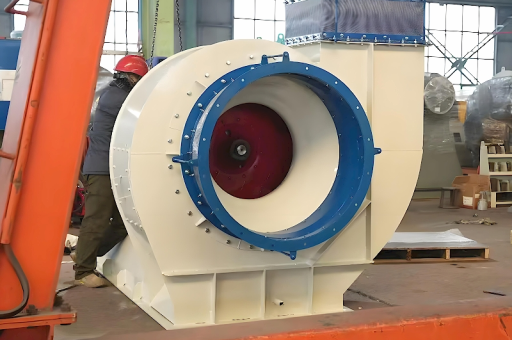
- What You Are Describing
- Breaking Down the Title Requirements
- Critical Technical Specifications to Look For
- Ideal Design & Material Suggestion
- What to Ask the Supplier (Critical Questions)
- Summary for Procurement
This is a very specific and technical product request. It describes a heavy-duty industrial fan designed for demanding boiler applications.
Here is a breakdown of what that description means, the key technical features you should expect, and why it meets the specified requirements.
What You Are Describing
You are looking for an Induced Draft (ID) Fan.
- Function: It pulls flue gases (combustion products) through the boiler, furnace, or heat exchanger, creating a negative pressure (draft) inside the system.
- Application: Used in thermal power plants, industrial steam boilers, biomass boilers, waste-to-energy plants, and large process heaters.
- The Environment: It handles hot, dusty, and often corrosive gases.
Breaking Down the Title Requirements
| Requirement | Meaning & Critical Importance |
|---|---|
| Customized | No standard fan fits all boilers. Customization must include: wheel type (radial/backward curved), housing material, shaft seal design (to prevent air leakage into hot gas), inlet box orientation, and motor base integration. |
| High Quality Carbon Steel | The primary material is Q235, Q345, or Q355B steel (or similar ASTM A36, A572). This offers high tensile strength and weldability at a lower cost than stainless steel. For induced draft, the "High Quality" often implies a thicker abrasion liner on the impeller and housing at the points where particulate matter impacts. |
| Large Flow | Measured in cubic meters per hour (m³/h) or cubic feet per minute (CFM) . This is typically > 100,000 m³/h. The housing and impeller are physically massive. |
| High Efficiency | Achieved through airfoil or backward-curved centrifugal impellers. Efficiency claims should be > 82-85% at the design operating point. It often requires a variable frequency drive (VFD) or inlet vanes for turndown. |
| Industrial Boiler | Designed for continuous 24/7 operation with high availability. Bearings must be heavy-duty (spherical roller) with an external cooling system (oil bath or circulating oil). |
| Induced Draft Fan | Must have a radial inlet box, a robust shaft seal (to prevent hot gas leakage to bearings), and a wheel designed to handle the flue gas load. |
Critical Technical Specifications to Look For
When ordering or evaluating a quote for this fan, you need these exact numbers:
- Flow Rate: _____ m³/hr or CFM (at standard conditions, then corrected to actual flue gas temperature).
- Static Pressure: _____ mmWC or Pa (inches w.g.) . This is critical for overcoming boiler resistance.
- Gas Temperature: _____ °C or °F (e.g., 140°C for a typical gas boiler, 250°C+ for a solid fuel boiler). This dictates the wheel design and shaft cooling.
- Gas Properties: Is it air, flue gas, or corrosive gas (SO2, etc.)? What is the dust load (mg/Nm³)?
- Speed: Driven by a motor (typically 4-pole or 6-pole) or via a pulley/belt. Large fans are often direct-coupled.
- Motor Power: _____ kW / HP.
Ideal Design & Material Suggestion
For a "High Quality Carbon Steel Large Flow High Efficiency Induced Draft Fan" , the design should look like this:
Impeller:
- Type: Backward curved airfoil blades (or flat/curved plates) . Airfoil is highest efficiency, but flat plates are more rugged for abrasive dust.
- Material: Q345B (High strength steel). Abrasion-resistant lining (e.g., 6-12mm thick) welded onto the leading edges and backplate.
- Weldments: All welds must be stress-relieved and 100% non-destructive tested (NDT).
Housing (Volute):
- Material: Q235B or Q345B.
- Lining: Removable or welded abrasion-resistant plates at the "cut-off" and "tongue" regions.
- Access: Large access doors for inspection and cleaning.
Shaft & Bearings:
- Shaft: Large diameter, high-grade carbon steel (e.g., 45# steel), ground to close tolerances.
- Bearing Assembly: Heavy-duty Spherical Roller Bearings in a split plummer block housing.
- Cooling: Fan-mounted cooling disc on the shaft (inside the housing) or a forged cooling wheel to protect the shaft bearings from the hot flue gas.
- Lubrication: Grease or circulating oil system.
Seals:
- Shaft Seal: Double-packing gland or a labyrinth seal with a purge air port (to prevent hot gas from leaking out of the housing onto the bearing pedestal).
Complete Assembly:
- Inlet Box: A 90-degree or radial inlet box to direct the gas from the duct into the eye of the fan.
- Inlet Damper: Variable Inlet Vanes (VIV) or a louver damper for flow control.
- Baseplate: A heavy duty, fully welded base with provisions for lifting and anchoring to a foundation.
What to Ask the Supplier (Critical Questions)
- "What is the specific design efficiency at my operating point (flow and pressure)?" Answer should be > 82%.
- "Is the impeller design backward curved or straight radial?" Backward curved is best for efficiency.
- "What is the critical speed of the shaft?" Operating speed should be at least 20-30% below the 1st critical speed.
- "How do you handle the high temperature to prevent thermal growth issues?" Answer must include: a flexible connection at the inlet, a sliding bearing support, or a thermally compensated base design.
- "Is the fan designed to operate with a VFD (Variable Frequency Drive)?" Must be balanced to an ISO 1940 G2.5 or G1.0 grade to handle variable speed.
Summary for Procurement
Best Product to Request: "A Customized Backward Curved Centrifugal Induced Draft Fan with a High Efficiency Airfoil Impeller fabricated from Q345B High Strength Carbon Steel with an abrasion-resistant lining. Designed for 100,000 m³/h at 3000 Pa at 180°C. Includes a radial inlet box, spherical roller bearings with a shaft cooling disc, and manual inlet vanes for flow control."
Expected Suppliers:
- International: Howden (US/UK), New York Blower (US), TLT-Babcock (Germany), Zitron (Spain).
- Chinese Major: Shandong Zhangqiu Blower Co., Ltd. (Fengfan brand), Shanghai Electric Blower Works, Shenyang Blower Works.
By specifying exactly these points, you will get a fan that is durable, high-performing, and optimized for its specific task in your industrial boiler system.





