
This article's table of contents introduction:
- Table of Contents (导读目录)
- Introduction: The Cement Industry’s Unsung Hero
- The Role of the Rotary Kiln in Cement Production
- Why High Power Air Supply is Critical for Kiln Efficiency
- Centrifugal Fans: The Core of Combustion and Cooling
- Key Design Considerations for High Power Centrifugal Fans in Cement Plants
- Common Challenges and Proven Solutions
- FAQ: Answering Your Most Pressing Questions
- Conclusion: Optimize Air Supply, Maximize Performance
** The Power Behind the Process: Optimizing High Power Air Supply in Industrial Cement Rotary Kilns with Centrifugal Fans
Table of Contents (导读目录)
- Introduction: The Cement Industry’s Unsung Hero
- The Role of the Rotary Kiln in Cement Production
- Why High Power Air Supply is Critical for Kiln Efficiency
- Centrifugal Fans: The Core of Combustion and Cooling
- Key Design Considerations for High Power Centrifugal Fans in Cement Plants
- Common Challenges and Proven Solutions
- FAQ: Answering Your Most Pressing Questions
- Conclusion: Optimize Air Supply, Maximize Performance
Introduction: The Cement Industry’s Unsung Hero
In the industrial cement manufacturing process, the rotary kiln is the heart of the operation. It is the massive cylindrical furnace where raw materials are heated to over 1,450°C to produce clinker. But this intense heat and chemical transformation would be impossible without a reliable, powerful air supply system. At the center of this system is the centrifugal fan—the unsung hero that delivers the high-pressure, high-volume air necessary for combustion, cooling, and material transport.
Modern cement plants are under constant pressure to increase output while reducing energy consumption and emissions. A well-engineered high power air supply system, powered by a robust centrifugal fan, directly influences kiln stability, fuel efficiency, and product quality. This article will explore the integral relationship between industrial cement rotary kilns and centrifugal fans, providing actionable insights for plant engineers and decision-makers.
The Role of the Rotary Kiln in Cement Production
A rotary kiln is a horizontally inclined, slowly rotating cylinder. Raw meal enters at the elevated end and moves toward the lower end, where a flame heats it to sintering temperatures. This process converts calcium carbonate and silica into calcium silicates—the key components of cement clinker.
The kiln has three critical zones:
- Preheating zone (up to 900°C): Moisture and carbon dioxide are driven off.
- Calcining zone (900–1,200°C): Calcium carbonate decomposes into calcium oxide.
- Sintering zone (1,200–1,450°C): Clinker compounds form.
Each zone requires specific air volumes and pressures to maintain thermal balance. This is where the centrifugal fan becomes indispensable.
Why High Power Air Supply is Critical for Kiln Efficiency
To achieve the required flame temperature and stable clinker quality, the high power air supply must overcome several physical constraints:
- Combustion air demand: Fuel (coal, petcoke, or natural gas) requires a precise air-to-fuel ratio. Insufficient air causes incomplete combustion and wasted fuel.
- Secondary and tertiary air flow: Heated air from the clinker cooler is drawn into the kiln, which requires high-pressure fan systems to maintain flow.
- Kiln draft control: The fan must create negative pressure or positive pressure depending on the section of the kiln and the configuration of the plant.
Without powerful centrifugal fans, these parameters become unstable, leading to higher fuel consumption, lower clinker output, and increased emissions.
Centrifugal Fans: The Core of Combustion and Cooling
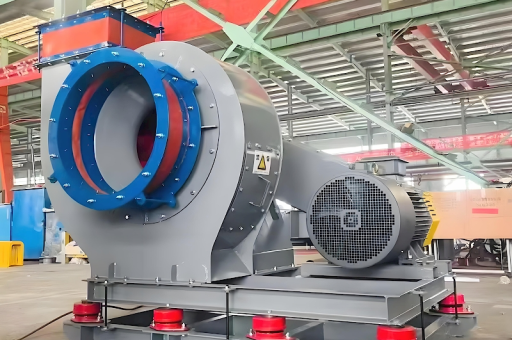
A centrifugal fan operates by accelerating air with a rotating impeller. In cement kiln applications, high power centrifugal fans are used in:
- Primary air fans: Deliver the main combustion air to the kiln burner.
- Cooler fans: Quench hot clinker and recover heat.
- Kiln ID fans: Maintain induced draft to pull gases through the system.
Key performance factors for these fans:
- Pressure capacity: Typically 2,000 to 8,000 Pa for kiln applications.
- Air volume: Ranges from 50,000 to 500,000 m³/h depending on kiln size.
- Power rating: Motors are often rated between 200 kW and 2,500 kW.
- Efficiency: Advanced aerodynamic blade designs (backward-curved or airfoil) can achieve 85%–90% efficiency.
Unlike standard industrial fans, those used in cement rotary kilns must withstand high temperatures (up to 350°C for raw gas fans) and abrasive dust particles. This requires heavy-duty construction with wear-resistant coatings and high-temperature bearings.
Key Design Considerations for High Power Centrifugal Fans in Cement Plants
When selecting or designing a centrifugal fan for a cement rotary kiln, engineers must evaluate:
A. Materials and Coatings
- Blade material: High-tensile steel with ceramic coating for abrasion resistance.
- Shaft sealing: Labyrinth seals or purge air systems to prevent dust ingress.
B. Motor and Drive System
- Variable frequency drives (VFDs): Enable precise speed control to match kiln demand, reducing energy consumption by 20–30%.
- Starting torque: High-inertia fans require soft starters or fluid couplings to avoid electrical stress.
C. Vibration and Noise Control
- Dynamic balancing of impellers is critical to avoid bearing failure.
- Supports and dampers: Spring or rubber isolators reduce structural vibration.
D. Maintenance Access
- Removable inlet cones and split housings facilitate impeller inspection and cleaning without full disassembly.
Common Challenges and Proven Solutions
Challenge 1: Fan Blade Erosion
- Cause: Abrasive raw meal and clinker dust.
- Solution: Use hard-faced or ceramic-lined blades; install wear plates.
Challenge 2: High Temperature Operation
- Cause: Hot kiln gases entering the fan.
- Solution: Cooling air injection or selecting fan materials rated for 400°C.
Challenge 3: Uneven Air Distribution
- Cause: Duct blockages or damper misalignment.
- Solution: Install static pressure sensors and automated damper control.
Challenge 4: Energy Inefficiency
- Cause: Fixed-speed fans running at constant full load.
- Solution: Retrofitting with VFDs to match air flow to real-time demand.
FAQ: Answering Your Most Pressing Questions
Q1: Why is a centrifugal fan preferred over an axial fan for cement kiln air supply? A: Centrifugal fans generate higher static pressure (2–8 kPa) compared to axial fans (generally <1 kPa). Kiln systems require high pressure to overcome the resistance of ductwork, preheaters, and material beds. Centrifugal fans are also more tolerant of dusty environments.
Q2: How do I calculate the required power for a kiln centrifugal fan? A: Use the formula: Power (kW) = (Airflow in m³/s × Pressure in Pa) ÷ (1000 × Fan Efficiency). For example, a fan moving 100 m³/s at 5,000 Pa with 85% efficiency requires approximately 588 kW. Always include a safety margin of 10–15%.
Q3: Can I upgrade an existing fan to improve kiln output? A: Yes. Retrofitting with a higher-efficiency impeller, upgrading to a VFD, or replacing the motor with a high-power unit can increase air supply without replacing the entire housing. However, structural and thermal limits must be checked first.
Q4: What maintenance schedule is recommended for high power centrifugal fans? A: Daily visual inspection for vibration, lubricant levels, and temperature. Monthly: Check belt tension, bearing alignment, and impeller wear. Annually: Perform dynamic balancing, replace bearings, and inspect shaft seals.
Conclusion: Optimize Air Supply, Maximize Performance
The seamless operation of an industrial cement rotary kiln depends on a reliable and efficient centrifugal fan delivering high power air supply. From combustion to cooling, every aspect of clinker production relies on controlled airflow. Investing in the right fan design—with high efficiency, durable materials, and intelligent speed control—pays dividends in reduced fuel consumption, lower emissions, and higher throughput.
Engineers and plant managers should prioritize fan audits, vibration monitoring, and regular maintenance to prevent unexpected downtime. In the competitive cement industry, the difference between a profitable plant and an underperforming one often comes down to the quality of the air supply system. Choose your centrifugal fan wisely, and let the power of air drive your kiln to peak performance.





