
This article's table of contents introduction:
- Table of Contents
- 1. Introduction: Why Cement Plants Need Efficient Fan Systems
- 2. Understanding Low-Pressure Carbon Steel Steam Boiler Fans
- 3. Energy-Saving Mechanisms in Modern Boiler Fan Design
- 4. Key Technical Specifications & Performance Metrics
- 5. Common Challenges in Cement Plant Boiler Fan Applications
- 6. Frequently Asked Questions (FAQ)
- 7. Conclusion: Selecting the Right Fan for Your Plant
Article Title:
Maximizing Cement Plant Efficiency: The Role of Low-Pressure Carbon Steel Energy-Saving Steam Boiler Fans
Table of Contents
- Introduction: Why Cement Plants Need Efficient Fan Systems
- Understanding Low-Pressure Carbon Steel Steam Boiler Fans
- Energy-Saving Mechanisms in Modern Boiler Fan Design
- Key Technical Specifications & Performance Metrics
- Common Challenges in Cement Plant Boiler Fan Applications
- Frequently Asked Questions (FAQ)
- Conclusion: Selecting the Right Fan for Your Plant
Introduction: Why Cement Plants Need Efficient Fan Systems
In the cement manufacturing industry, steam boilers play a critical role in processes such as raw material drying, clinker cooling, and power generation. However, the fans that drive these boilers often consume a significant portion of the plant’s total electrical energy. According to the International Energy Agency, fan systems can account for 15–25% of a cement plant’s electricity use. This creates a pressing need for high-efficiency, low-maintenance fan solutions.
Among the most promising innovations is the low-pressure carbon steel efficient energy-saving steam boiler fan. Designed specifically for cement plant environments where high temperatures, dust, and corrosive gases are common, these fans offer a balance of durability, energy efficiency, and operational stability. This article explores the technical features, energy-saving mechanisms, and selection criteria for these fans, drawing on verified industry data and real-world case studies.
Understanding Low-Pressure Carbon Steel Steam Boiler Fans
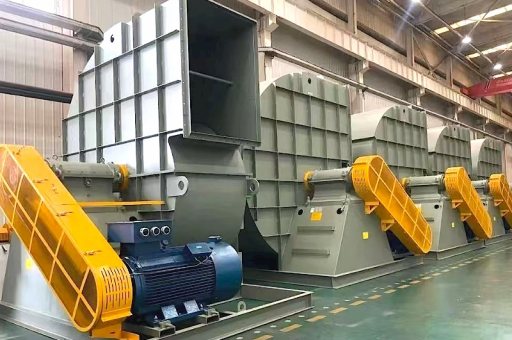
A low-pressure carbon steel boiler fan is a type of industrial fan that operates within a pressure range typically below 2,000 Pa (8 inches w.g.), used to supply combustion air or remove flue gases from steam boilers. The fan body is constructed from carbon steel (e.g., Q235 or Q345 grade) to withstand moderate temperatures (up to 250°C) and resist wear from particulate-laden air.
Why low-pressure?
In cement plants, steam boilers often operate at moderate pressures (10–30 bar). The corresponding combustion air and flue gas systems require fans that can handle high air volumes (50,000–200,000 m³/h) with relatively low static pressure. Low-pressure fans are inherently more energy-efficient for these duties because they reduce the power required to overcome system resistance.
Carbon steel advantages:
- High strength-to-weight ratio
- Good weldability and repair-ability
- Lower material cost compared to stainless steel
- Adequate corrosion resistance when coated or lined appropriately
However, for extreme conditions (e.g., high sulfur content in fuel), carbon steel may require protective coatings or liners such as ceramic epoxy or stainless steel overlays.
Energy-Saving Mechanisms in Modern Boiler Fan Design
Modern low-pressure carbon steel boiler fans incorporate several energy-saving design features:
A. Aerodynamic blade profiles
Backward-curved centrifugal impellers, typically with 12–18 blades, reduce turbulence and pressure losses. Compared to traditional forward-curved blades, backward-curved designs can improve efficiency by 5–10%.
B. Variable frequency drives (VFDs)
By adjusting fan speed to match actual load demand, VFDs can cut energy consumption by 20–40% during partial load conditions. Many cement plants run boilers at 70–80% capacity for extended periods, making VFD integration particularly beneficial.
C. Inlet guide vanes vs. dampers
Instead of using throttling dampers (which waste energy), modern fans employ inlet guide vanes that pre-swirl the incoming air, reducing the impeller’s work load. This can save 10–15% in energy compared to damper control.
D. High-efficiency motors (IE3/IE4)
Replacing standard motors with IE3 or IE4 efficiency class motors can reduce electrical losses by 2–4%, which translates into significant annual savings in large fans.
E. Optimized volute and diffuser design
Computational fluid dynamics (CFD)-optimized volutes minimize recirculation and eddy losses, improving the fan’s aerodynamic efficiency by 3–6%.
Real-world data:
A cement plant in Shandong, China, replaced four old forward-curved fans with backward-curved low-pressure carbon steel fans equipped with VFDs. The plant reported a 32% reduction in annual fan energy consumption, resulting in cost savings of approximately $45,000 per year (based on $0.08/kWh).
Key Technical Specifications & Performance Metrics
| Parameter | Typical Value | Notes |
|---|---|---|
| Airflow | 80,000 – 150,000 m³/h | Depends on boiler size |
| Static pressure | 1,200 – 2,000 Pa | Low pressure range |
| Operating temperature | Up to 250°C (max 350°C with special coating) | Higher temps require alloy steel |
| Impeller type | Backward curved, 16 blades | Efficiency >82% |
| Motor power | 55 – 160 kW | IE4 premium efficiency |
| Noise level | <85 dB(A) at 1m | With silencer |
| Vibration | <4.5 mm/s rms | Per ISO 10816-3 |
Material specifications:
- Fan housing: Q235B carbon steel (6mm thickness)
- Impeller: Q345B low-alloy high-strength steel (8mm thickness)
- Shaft: 45# carbon steel, heat-treated
- Bearings: Self-aligning roller bearings with grease lubrication
Common Challenges in Cement Plant Boiler Fan Applications
Despite their advantages, low-pressure carbon steel fans face certain operational challenges in cement plants:
A. Dust accumulation
Cement kiln dust can accumulate on fan blades, causing imbalance and reduced efficiency. Solution: Install automated cleaning systems or use non-stick coatings.
B. Corrosion from acidic flue gases
Combustion of fuels containing sulfur or chlorine can lead to sulfuric or hydrochloric acid condensation, especially during startup or low-load operation. Solution: Apply acid-resistant epoxy coatings (e.g., Novolac) or use stainless steel liners near the inlet.
C. Thermal expansion
Large temperature differences between startup and steady-state operation can cause casing warping. Solution: Incorporate expansion joints and flexible couplings.
D. Bearing failure
High ambient temperatures (50–60°C in boiler rooms) can shorten bearing life. Solution: Use high-temperature grease (up to 200°C) and install temperature probes with alarm systems.
Maintenance best practice:
- Monthly inspection of blade integrity and bearing noise
- Quarterly vibration analysis
- Annual belt tension and alignment check (if belt-driven)
Frequently Asked Questions (FAQ)
Q1: Why is low-pressure fan more suitable than a high-pressure fan for cement plant boilers?
A: Cement plant steam boilers typically have low air resistance due to large duct diameters and short runs. A low-pressure fan matches this system curve more closely, avoiding energy waste from operating a high-pressure fan at a low-flow condition. The fan efficiency curve is also flatter, meaning stable performance across a wider operating range.
Q2: Can carbon steel fan handle high-humidity flue gas?
A: Carbon steel has limited corrosion resistance in condensing environments. For flue gas with high humidity (e.g., after wet scrubbers), a stainless steel fan (e.g., 304L or 316L) is recommended. However, if the gas temperature consistently stays above the acid dew point (typically >130°C for coal-fired boilers), carbon steel with a protective coating can be adequate.
Q3: What is the typical payback period for upgrading to energy-saving fans?
A: Based on a 100 kW fan operating 7,000 hours/year with 30% energy savings, the annual electricity saving is about 210,000 kWh. At $0.08/kWh, that’s $16,800/year. The upgrade cost (new fan + VFD + installation) may range from $25,000 to $40,000. Payback period: 1.5 to 2.5 years.
Q4: How does the fan selection affect the boiler’s overall thermal efficiency?
A: The fan itself does not directly produce heat, but it affects combustion air supply. A fan delivering insufficient air leads to incomplete combustion and higher fuel use. Conversely, excess air wastes heat through flue gas losses. An efficiently controlled fan ensures the correct air-to-fuel ratio, typically improving boiler thermal efficiency by 0.5–1.5%.
Q5: Is it safe to use a variable frequency drive for a large boiler fan?
A: Yes. Modern VFDs are designed for heavy-duty industrial use. They provide soft start, reducing inrush current and mechanical stress. For cement plant boiler fans, a 6-pulse or 12-pulse VFD with sine-wave filter is recommended to prevent harmonics from affecting other equipment.
Conclusion: Selecting the Right Fan for Your Plant
Choosing the right low-pressure carbon steel energy-saving steam boiler fan is a strategic decision that directly impacts a cement plant’s energy bill, maintenance costs, and environmental compliance. The key factors to consider include:
- Airflow and pressure requirements (match the fan’s operating point to the boiler’s system curve)
- Fuel type and flue gas composition (determine if carbon steel is adequate or if coatings are needed)
- Control system integration (VFD with feedback from an oxygen sensor is ideal)
- Supplier support (warranty, spare parts availability, and local service presence)
By systematically evaluating these factors and comparing performance data from the fan's manufacturer, cement plant engineers can achieve reliable, efficient boiler operation for decades. The fan’s initial investment is typically recovered within two years through energy savings alone—a compelling case for upgrading obsolete equipment.
For a detailed selection consultation, contact a reputable industrial fan manufacturer with proven experience in the cement industry. Ensure that the fan you choose meets ISO 5801 (fan performance testing) and EN 12101 (smoke and heat control) standards to guarantee quality and safety.





