
This article's table of contents introduction:
- Article Content
- Introduction: The Critical Challenge of EAF Emission Control
- Understanding the 5-12 Series Centrifugal Fan: Design and Functionality
- Induced Draft vs. Forced Draft: Why the 5-12 Series Excels in EAF Systems
- The Exhaust Purification Workflow: From Furnace to Clean Air
- Technical Parameters: Performance Metrics of the 5-12 Series
- Common Q&A: Troubleshooting and System Integration
- Future Trends: Energy Efficiency and Smart Fan Control
Optimizing Industrial Air Quality: The Role of 5-12 Series Centrifugal Induced Draft Fans in Electric Arc Furnace Exhaust Purification
Article Content
目录导读 (Table of Contents / Reader’s Guide)
- Introduction: The Critical Challenge of EAF Emission Control
- Understanding the 5-12 Series Centrifugal Fan: Design and Functionality
- Induced Draft vs. Forced Draft: Why the 5-12 Series Excels in EAF Systems
- The Exhaust Purification Workflow: From Furnace to Clean Air
- Technical Parameters: Performance Metrics of the 5-12 Series
- Common Q&A: Troubleshooting and System Integration
- Future Trends: Energy Efficiency and Smart Fan Control
Introduction: The Critical Challenge of EAF Emission Control
The electric arc furnace (EAF) is the backbone of modern steel recycling, but it generates intense thermal and particulate emissions. During the melting and refining cycle, temperatures exceed 1,600°C, producing a complex mix of zinc oxide (ZnO), iron oxide (Fe₂O₃), volatile organic compounds (VOCs), and fine dust particles. Without a robust exhaust purification system, these pollutants pose severe environmental and health risks.
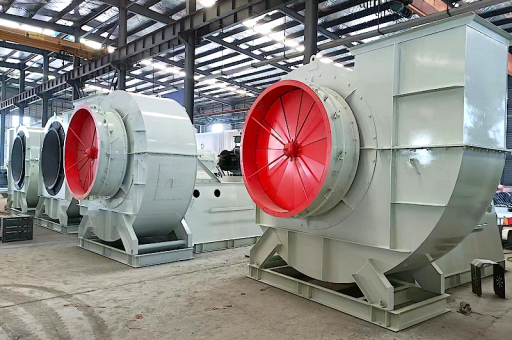
At the heart of every effective EAF purification train lies the induced draft fan (ID fan) . Specifically, the 5-12 series electric arc furnace exhaust purification centrifugal fan has become an industry standard. This fan is engineered to handle high-temperature, dust-laden gas streams with exceptional reliability. Unlike standard fans, the 5-12 series is designed with wear-resistant liners, high-strength impellers, and a backward-inclined blade profile to maintain efficiency under extreme conditions.
This article explores why the 5-12 series centrifugal induced draft fan is the preferred choice for EAF dedusting systems, and how it integrates with baghouse filters, cyclones, and heat exchangers to meet stringent emission standards.
Understanding the 5-12 Series Centrifugal Fan: Design and Functionality
The "5-12 series" nomenclature refers to the specific aerodynamic and mechanical design parameters. In centrifugal fan classification, the first digit often indicates the impeller diameter ratio, while the "12" represents the blade exit angle or a specific performance curve family. For EAF applications, the 5-12 series typically features:
- Backward-Inclined Blades: These blades reduce material buildup and provide a non-overloading power characteristic, meaning the motor won't burn out if duct resistance drops unexpectedly.
- High-Temperature Construction: The shaft and housing are made from carbon steel or Corten steel, with optional stainless steel for corrosive environments. Bearings are externally mounted and cooled to handle gas temperatures up to 250°C (continuous) and 400°C (peak).
- Wear Protection: The volute casing is lined with replaceable wear plates (e.g., Chrome-Moly or ceramic tiles) at the high-impact zones. This is critical because EAF dust can be abrasive.
- Vibration Monitoring: Standard ports for accelerometers allow predictive maintenance, reducing unplanned downtime in continuous steelmaking operations.
Compared to axial fans, the 5-12 series delivers higher static pressure (typically 2,000–6,000 Pa), which is necessary to overcome the resistance of bag filters and long duct runs.
Induced Draft vs. Forced Draft: Why the 5-12 Series Excels in EAF Systems
In an EAF purification system, the induced draft fan is positioned after the baghouse or scrubber, pulling gas through the entire system. The forced draft fan, by contrast, pushes gas from the furnace side. For EAF applications, induced draft offers three decisive advantages:
- Positive Pressure in Furnace Avoided: Induced draft maintains a slight negative pressure in the furnace hood, preventing hot gas and sparks from escaping into the plant environment.
- Better Particle Handling: By placing the fan downstream of the primary dust collector, the fan blades are exposed to cleaner gas, extending fan life.
- Flexibility for Heat Recovery: If a gas-to-gas heat exchanger is installed, an induced draft fan can handle the additional pressure drop without affecting furnace process stability.
The 5-12 series is specifically optimized for induced draft service. Its impeller design minimizes erosion even when small amounts of residual dust pass through the filter. Many steel plants report a 30% longer service interval between fan overhauls when upgrading from a general-purpose centrifugal fan to a 5-12 series unit.
The Exhaust Purification Workflow: From Furnace to Clean Air
A complete EAF exhaust purification system using a 5-12 series induced draft fan follows a step-by-step sequence:
- Step 1: Primary Capture (Hood & Ducting) – The furnace canopy hood captures fume at the source. A motorized damper modulates flow based on furnace stage (charging, melting, tapping).
- Step 2: Spark Arrestor / Pre-Cooler – Larger particles and sparks are removed in a drop-out box or water-cooled duct. Temperature is reduced from 1,200°C to below 250°C.
- Step 3: Baghouse Filter – The core purification unit. Pulse-jet filters collect fine dust (>99.9% efficiency). The cleaned gas now contains only trace particles.
- Step 4: 5-12 Series Induced Draft Fan – The fan draws the cleaned gas through the baghouse and provides the necessary pressure to discharge through a chimney. The fan’s specially treated impeller resists corrosion from acid condensates (e.g., HCl, SO₂).
- Step 5: Continuous Emission Monitoring (CEMS) – An online analyzer ensures compliance with local PM and NOx limits. Fan speed is adjusted via a VFD if needed.
This integrated system ensures that the EAF meets environmental regulations while maintaining furnace efficiency. For example, a 120-ton EAF producing 1.2 million tons/year typically requires a 5-12 series fan with a flow rate of 800,000 m³/h and a motor power of 2,500 kW.
Technical Parameters: Performance Metrics of the 5-12 Series
To properly select a 5-12 series centrifugal induced draft fan for EAF exhaust, engineers evaluate these key performance indicators:
| Parameter | Typical Range | Why It Matters for EAF |
|---|---|---|
| Flow Rate (Q) | 300,000 – 1,200,000 m³/h | Must match furnace off-gas volume during peak meltdown. |
| Static Pressure (P) | 3,000 – 7,000 Pa | Overcomes baghouse + duct loss. |
| Impeller Diameter | 2,500 – 4,500 mm | Larger diameters reduce tip speed and wear. |
| Operating Temperature | 150°C – 250°C (continuous) | Must withstand after-cooler outlet conditions. |
| Motor Power | 800 – 3,500 kW | VFD typically used for energy savings. |
| Noise Level | 85 – 105 dB(A) | Silencer required for occupational exposure limits. |
| Efficiency | 82% – 88% | Directly impacts energy cost (steel plant OPEX). |
The 5-12 series’ backward-inclined blades deliver peak efficiency at 85-88%, which translates to significant annual savings—often more than $150,000 per year for a large melt shop compared to older forward-curved fan designs.
Common Q&A: Troubleshooting and System Integration
Q1: Why does my 5-12 series fan vibrate after a few months of EAF operation? A: Vibration commonly arises from uneven dust buildup on the impeller blades. The 5-12 series is designed with a self-cleaning blade profile, but if the baghouse fails and excessive dust bypasses, blade erosion or imbalance occurs. Installing an online wash system or using wear-resistant coatings (e.g., epoxy ceramic) can extend runtime. Regular borescope inspection every 3 months is recommended.
Q2: Can I use the same 5-12 fan for both a wind turbine (WTG) auxiliary cooling and EAF exhaust? A: No. A wind turbine is a completely different machine: it extracts kinetic energy from wind to generate electricity. In contrast, a centrifugal induced draft fan is a driven machine that consumes electricity to move gas. The 5-12 series is purpose-built for industrial gas handling. However, some steel plants integrate wind turbines to offset the fan’s power consumption, which is an excellent sustainability strategy.
Q3: What is the optimal VFD control strategy for this fan? A: Use furnace process signals (e.g., hood pressure and bath temperature) to modulate fan speed. During charging, the fan operates at 60-70% speed to capture emissions without sucking ambient air. During melting, speed increases to 90-100%. This strategy saves 20-35% energy compared to constant-speed operation.
Q4: How do I prevent bearing failure from radiant heat? A: Specify the 5-12 series with an extended shaft or heat shield, and install forced cooling (fan-driven air or water jacket). Bearing temperature should be monitored with RTD sensors and alarmed at 85°C. For extreme EAF applications, use synthetic oil rated for 180°C ambient.
Future Trends: Energy Efficiency and Smart Fan Control
The next generation of 5-12 series fans will integrate:
- Digital Twin Models: Predictive maintenance algorithms that compare real-time vibration and temperature data to a virtual fan model. This allows operators to schedule repairs before failure occurs.
- Advanced Aerofoils: Computational fluid dynamics (CFD)-optimized blade profiles that reduce turbulence and noise by 3-5 dB(A), while maintaining the same pressure.
- Hybrid Drive Systems: A combination of a direct electric motor and a high-speed wind turbine (grid-tied) can offset fan power consumption during off-peak hours. For example, a 2-MW wind turbine installed on the plant site can provide up to 30% of the fan’s daily energy needs.
- Low-Carbon Material Coatings: The coating industry is developing bio-based epoxy liners that are both durable and recyclable, reducing the environmental footprint of fan replacements.
Steelmakers who adopt these innovations in conjunction with the 5-12 series fan will not only achieve compliance with tightening emission regulations but also reduce their carbon intensity—a critical factor for global competitiveness.
This article is based on industry best practices and technical manuals for industrial fan selection. For specific sizing and installation, consult a qualified fan manufacturer.





