
This article's table of contents introduction:
- What does 10,000 Pa mean?
- Key Characteristics of a 10,000 Pa Centrifugal Fan
- Typical Applications (Where you find 10,000 Pa fans)
- How to Read a Fan Curve (Crucial for Selection)
- Selection Considerations
- Summary Table
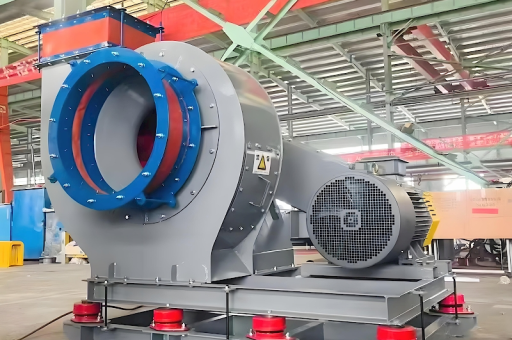
Here is a comprehensive overview of a 10,000 Pa (Pascal) centrifugal fan, covering what that pressure specification means, typical applications, design characteristics, and how to select one.
What does 10,000 Pa mean?
- Pressure (Static Pressure): 10,000 Pa is equivalent to 1,000 mmH₂O (millimeters of water column) or approximately 45 PSI.
- High Static Pressure: This is a very high static pressure rating. For context:
- A standard household fan produces < 50 Pa.
- A typical bathroom vent fan produces ~ 75 Pa.
- An industrial fume extractor might produce 1,500 - 3,000 Pa.
- 10,000 Pa is firmly in the realm of heavy-duty industrial and specialized applications. It indicates the fan can overcome significant resistance from long duct runs, dense filters, material conveying, or high system backpressure.
Key Characteristics of a 10,000 Pa Centrifugal Fan
To generate this level of pressure, the fan must have specific design features:
-
Impeller Type: It will almost exclusively be a Backward Curved or Airfoil impeller.
- Backward Curved (BC): High efficiency, non-overloading power curve (motor won't burn out if airflow is accidentally blocked). The blade curves away from the direction of rotation.
- Airfoil: A specialized backward curved blade with an airfoil cross-section. The most efficient design for high static pressure, but also the most expensive.
- Note: Forward Curved (squirrel cage) fans are not suitable for this pressure range; they are for low-pressure, high-volume applications.
-
Speed (RPM): These fans typically run at very high speeds. You'll often see belt-driven configurations or high-frequency direct drives. A direct-drive motor at 2,900 or 3,450 RPM is common for smaller models, while larger units might use a motor running at 3,600 RPM or be coupled via belts to run at even higher speeds (e.g., 4,000 - 6,000 RPM).
-
Housing & Construction: The housing must be very robust to contain the pressure and handle the stress.
- Material: Heavy-gauge steel (often with welded seams), stainless steel (for corrosive or hygienic applications), or cast aluminum.
- Reinforcement: The scroll housing will have substantial bracing. The inlet and outlet flanges are standard heavy-duty designs.
-
Motor: The motor must be matched precisely.
- Power: Can range from a few kW for a very small unit to 100+ kW for a large industrial fan. As a rough guide, 10,000 Pa requires significantly more power than a low-pressure fan moving the same airflow.
- Enclosure: Typically TEFC (Totally Enclosed Fan Cooled) for industrial environments.
Typical Applications (Where you find 10,000 Pa fans)
- Pneumatic Conveying Systems: Moving materials like plastic pellets, cement, wood chips, grains, or powders through pipes. The high pressure overcomes the friction of the air/material mixture.
- Dust Collection / Baghouse Systems: Pulling air through dense fabric filter bags. The high static pressure is needed to draw air through the filter cake (the dust layer on the bags).
- Industrial Process Drying: Forcing hot air through deep beds of material (e.g., drying textiles, chemicals, food) that create high resistance.
- Central Vacuum Systems: Large industrial vacuum systems for cleaning factories or processing plants.
- High-Resistance HVAC & Filtration: Cleanrooms, hospital operating rooms, or laboratories with HEPA filters and extensive, complex ductwork.
- Environmental Chambers: Wind tunnels or test chambers that require controlled high-pressure airflow.
How to Read a Fan Curve (Crucial for Selection)
You cannot simply buy a "10,000 Pa fan." The pressure depends on the airflow.
A fan curve is a graph. You need to know your Operating Point.
- X-Axis (Flow Rate): Generally in m³/h (cubic meters per hour) or CFM (cubic feet per minute).
- Y-Axis (Pressure): In Pa (or mmH₂O, inWG).
- System Curve: Your specific ductwork, filters, etc., create a backpressure that increases with flow.
- The Intersection: The fan operating point is where the fan curve intersects your system curve.
Example:
- A small 10,000 Pa fan might achieve 10,000 Pa only at a very low flow (e.g., 500 m³/h).
- A large 10,000 Pa fan might achieve 10,000 Pa while moving 10,000 m³/h.
You need to specify both the required pressure AND the required volume.
Selection Considerations
- Airflow (Volume): What is your required CFM or m³/h?
- Static Pressure: What is the total resistance of your system?
- Air Temperature & Conditions: Is the air clean, dusty, hot, or corrosive? This dictates material (steel, SS, or coated) and bearing type.
- Drive Type:
- Direct Drive: Simple, no belts to maintain, less slippage. Good for constant speed.
- Belt Drive: Allows for speed changes (by changing sheaves) to fine-tune performance. More forgiving if your system resistance is slightly off. Highly recommended for 10,000 Pa applications to allow for field adjustment.
- Safety Margin: For industrial applications, it's wise to select a fan that can handle at least 10-15% more pressure than your calculated system resistance. This accounts for dirty filters or future duct modifications.
Summary Table
| Feature | Typical Low-Pressure Fan | 10,000 Pa High-Pressure Fan |
|---|---|---|
| Pressure | < 1,000 Pa | 10,000 Pa |
| Impeller | Forward Curved | Backward Curved / Airfoil |
| Housing | Light-gauge, formed | Heavy-gauge, welded, reinforced |
| Speed | < 1,500 RPM | 2,900 - 6,000+ RPM |
| Power | Low (kW) | High (kW) |
| Application | Comfort ventilation | Pneumatic conveying, dense filtration |
Final Recommendation: If you need a 10,000 Pa centrifugal fan, do not buy based on pressure alone. You must work with an industrial fan supplier and provide:
- Required airflow volume (m³/h or CFM)
- Actual system static pressure (Pa or inWG) or a description of your system (duct length, filters, material being moved)
- Temperature and material of the airstream
The supplier will then use their fan selection software to find the exact model that meets your operating point.





